
Hikvision DS-7608NXI-K1/8P(D) – 8-Channel AcuSense 4K NVR
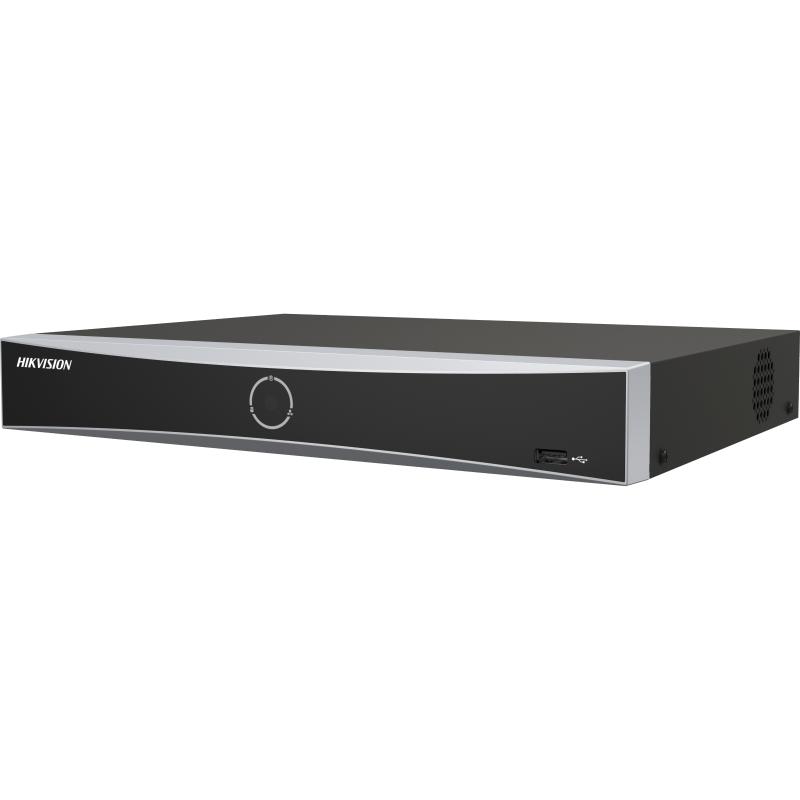
This is the recorder most eight-camera jobs end up on, and for good reasons: eight channels, eight PoE ports, 4K on the HDMI, AcuSense, and a single drive bay that takes 16 TB. One box, one power lead, no separate switch.
It is also the box where two numbers quietly decide the design, and neither of them is the channel count. The PoE budget is 75 watts across all eight ports, and the uplink is a single 10/100 port. Eight ports do not mean eight cameras of any kind, and 80 Mbps of recording does not mean 80 Mbps of remote viewing.
The arithmetic is below, worked through against the cameras in this catalogue rather than left as a datasheet line.
- 8 IP channels, 8 PoE ports, plug and play
- 80 Mbps in, 80 Mbps out — 10 Mbps per camera
- 4K HDMI at 30 Hz plus an independent VGA output
- 1 SATA bay, up to 16 TB — no RAID
- 75 W total PoE, 802.3af and 802.3at
- AcuSense: human and vehicle recognition to reduce false alarms
- Face picture comparison on 4 channels, 16 libraries, 20,000 pictures
- Alarm terminals only on the /Alarm4+1 order code
What actually fits
Three constraints bind a design on this recorder, and only one of them is obvious from the model number.
PoE budget — the one that catches people out
Eight ports share 75 W. Because the channel count and the port count match, it is easy to assume eight cameras of any type will fit. Power says otherwise.
| Camera | PoE class | Draw | How many fit in 75 W |
| DS-2CD2047G3-LI2UY | 802.3af Class 3 | 6.5 W | 8 — 52 W, comfortable |
| DS-2CD2047G2H-LIU | 802.3af Class 3 | 7 W | 8 — 56 W |
| DS-2CD2046G3-IZ2UY/SL | 802.3at Class 4 | 16 W | 4 — 64 W, and nothing else |
A mixed load has to be added up rather than assumed. Two strobe cameras plus six hybrid-light cameras is 32 + 39 = 71 W and fits. Three plus five is 80.5 W and does not. Once you go past the budget you are buying an injector or a separate PoE switch, at which point the built-in ports have stopped being the reason you chose this box.
Incoming bandwidth
80 Mbps across eight channels is 10 Mbps per camera. The 4 MP cameras in this catalogue top out at 8 Mbps on the main stream and add a sub-stream on top, so a full eight-camera load running flat out sits close to the ceiling. In practice H.265+ on a mostly static scene lands far below that — but a site with constant movement on every camera is exactly the site where the comfortable estimate stops holding.
Retention
One SATA bay, up to 16 TB, no RAID and no redundancy: a failed disk is a lost archive. Continuous recording, eight channels of 4 MP H.265:
| Main stream | Per day, 8 channels | 8 TB | 16 TB |
| 4 Mbps | approx. 346 GB | approx. 23 days | approx. 46 days |
| 8 Mbps, the maximum | approx. 691 GB | approx. 11 days | approx. 23 days |
Event-based recording stretches these figures considerably and unpredictably, because it depends entirely on how busy the site is. Quote the continuous numbers and let the customer be pleasantly surprised, rather than the other way round.
Three things the datasheet states plainly and people still miss
This is not the VPro. DS-7608NXI-K1/8P/VPro is a different recorder in a different series — same channel count, same port count, but with AcuSeek natural-language event search. The (D) is a Pro Series AcuSense hardware revision. The two are easy to transpose on an order and they do not cost the same. If the customer has been promised search in plain English, they have been promised the VPro.
The uplink is 100 Mbps, not gigabit. Outgoing bandwidth is quoted at 80 Mbps through a single self-adaptive 10/100 port. Remote viewing, playback download and any cloud upload all share what is left after overhead. On a site where several people watch remotely at the same time, this is the first thing to feel tight — and it cannot be fixed by upgrading the broadband.
Recorder-side AI is thin, and that is fine. Perimeter protection by the device runs on exactly one channel at 4 MP; facial detection runs on one channel. Motion detection 2.0 with human and vehicle recognition does cover all channels. The design assumption is that the cameras do their own AcuSense classification and the recorder stores the result, which is how every camera in this catalogue is specified anyway. Do not sell recorder-side analytics across eight channels: this box does not have it.
Two smaller ones. Alarm inputs and outputs exist only on the DS-7608NXI-K1/8P(D)/Alarm4+1 order code — the base model has none, so a gate contact or an intruder panel input has to be specified at order. And working temperature is -10 °C to 55 °C, which is a room specification: an unheated garage in a British winter is inside it, an uninsulated shed is a gamble.
Full specification
Intelligent analytics
| AI by device | Facial recognition, perimeter protection, motion detection 2.0 |
| AI by camera | Facial recognition, perimeter protection, throwing objects from building, motion detection 2.0, ANPR, VCA |
| Motion detection 2.0 by device | All channels at 4 MP, up to 8 MP with enhanced SVC mode; human and vehicle recognition to reduce false alarms |
| Perimeter protection by device | 1 channel, 4 MP |
| Facial detection and analytics | Face picture comparison, human face capture, face picture search; 1 channel at 8 MP |
| Face picture comparison | 4 channels |
| Face picture library | Up to 16 libraries, 20,000 pictures in total, each picture 4 MB or less, total 1 GB or less |
Video, audio and decoding
| IP video input | 8 channels |
| Incoming bandwidth | 80 Mbps |
| Outgoing bandwidth | 80 Mbps |
| HDMI output | 1 channel, up to 4K 3840 × 2160 at 30 Hz |
| VGA output | 1 channel, up to 1920 × 1080 at 60 Hz |
| Video output mode | HDMI and VGA independent output |
| CVBS output | None |
| Audio | 1 channel RCA output; 1 channel two-way audio |
| Decoding format | H.265, H.265+, H.264+, H.264 |
| Recording resolution | 12, 8, 6, 5, 4 and 3 MP; 1080p; UXGA; 720p; VGA; 4CIF, DCIF, 2CIF, CIF, QCIF |
| Synchronous playback | 8 channels |
| Decoding, AI on | 2 × 12 MP, 3 × 8 MP, 6 × 4 MP or 12 × 1080p, all at 30 fps |
| Decoding, AI off | 2 × 12 MP, 4 × 8 MP, 8 × 4 MP or 16 × 1080p, all at 30 fps |
| Audio compression | G.711ulaw, G.711alaw, G.722, G.726, AAC |
Network, PoE and storage
| Network interface | 1 self-adaptive 10/100 Mbps Ethernet interface |
| PoE interfaces | 8 × RJ-45 10/100 Mbps self-adaptive |
| PoE power | 75 W or less, total |
| PoE standard | IEEE 802.3af and 802.3at |
| Remote connection | 128 |
| API | ONVIF Profile S and G; SDK; ISAPI |
| Network protocol | TCP/IP, DHCP, IPv4, IPv6, DNS, DDNS, NTP, RTSP, SADP, SMTP, SNMP, NFS, iSCSI, ISUP, UPnP, HTTP, HTTPS |
| Compatible browser | IE11, Chrome 57, Firefox 52, Safari 12, Edge 89 or above |
| SATA | 1 interface, up to 16 TB per drive |
| USB | Front: 1 × USB 2.0; rear: 1 × USB 2.0 |
| Alarm in / out | None on the base model; 4 in and 1 out on the /Alarm4+1 order code |
Power, housing and approvals
| Power supply | 48 VDC, 1.875 A |
| Consumption | 10 W or less, without a drive and with PoE off |
| Working temperature | -10 °C to 55 °C |
| Working humidity | 10% to 90% |
| Dimensions | 320 mm × 240 mm × 48 mm |
| Weight | 1 kg or less, without a drive |
| Certification | CE, FCC, IC, CB, KC, UL, RoHS, REACH, WEEE, RCM, UKCA, LOA, BIS |
Available as DS-7608NXI-K1/8P(D) and DS-7608NXI-K1/8P(D)/Alarm4+1. Also written DS-7608NXI-K1-8P-D and DS7608NXIK18PD. For the same channel count with AcuSeek natural-language search, see the DS-7608NXI-K1/8P/VPro; for two drive bays instead of one, see the DS-7608NXI-K2/8P(E). Specification sourced from the manufacturer datasheet, DS-7608NXI-K1/8P(D), 23 May 2024.
Works with SmartGard.AI
A recorder answers one question well: what happened, and can I see it again. It keeps the footage, it holds the retention, and when something has gone wrong it is where the evidence lives. What it does not do is tell you that something is going wrong now, in terms a person would use.
SmartGard.AI does not replace this box and does not want to. The cameras keep recording to it exactly as they would otherwise, and the archive stays local and stays yours. What the layer adds sits alongside: when a camera reports an event, the frames from that event are read against zone rules written in plain language, and the system decides whether it is worth telling anybody about.
That matters more on a recorder like this one than on a larger box, because device-side analytics here amount to one channel of perimeter protection. The intelligence has to come from somewhere, and the two honest options are the cameras and the cloud.
Two limits worth stating. Each event is judged on its own — there is no correlation between cameras, so a person crossing three fields of view produces three separate judgements rather than one tracked path. And nothing is watched continuously: analysis runs when an event fires or when a patrol is requested from the app. This is a layer that decides what deserves your attention, not a monitored alarm system with a receiving centre behind it.
Already have a recorder and cameras installed? The same layer retrofits onto most modern IP installations without replacing what you already own.