
Hikvision DS-2CD2046G3-IZ2UY/SL – 4 MP AcuSense Varifocal Bullet with Strobe
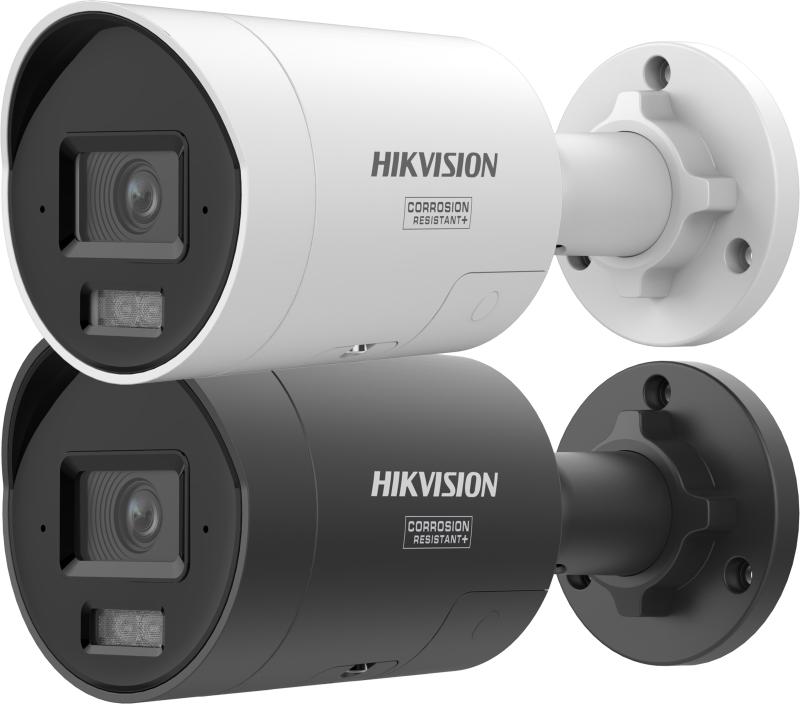
Most cameras record an intrusion and leave you to find out about it in the morning. This one argues back. When the deep-learning classifier decides it is looking at a person or a vehicle rather than a fox or a branch, a white strobe fires and a 110 dB speaker plays whatever warning you loaded into it.
The other half of the model number is the lens. It is motorised across 2.8 to 4 mm, which is a modest range and entirely the point: the angle is set from a laptop rather than from a ladder, and it can be retuned six months later when the customer moves a bin store or puts up a fence. On a soffit at four metres that is the difference between a phone call and a second visit.
Be clear about what it is not. This is a DarkFighter camera on a 1/3″ sensor at F1.6, with infrared supplement light. After dark it produces a monochrome picture. The white light on the /SL is an alarm flash, not an illuminator.
- Motorised varifocal 2.8–4 mm — remote angle adjustment, no ladder
- White strobe and 110 dB speaker, triggered by human and vehicle classification
- 4 MP, 2688 × 1520; 99.3° at 2.8 mm down to 80.0° at 4 mm
- DORI to 79 m detect at 4 mm — the longest reach of the 4 MP bullets here
- Infrared to 40 m, 850 nm, smart supplement light
- Two built-in microphones, two-way audio
- NEMA 4X anti-corrosion, IP67, all-metal, 515 g
- PoE 802.3at Class 4, max 16 W — budget for it
One digit apart, built for opposite jobs
The DS-2CD2046G3 and the DS-2CD2047G3 differ by one character and get ordered by mistake often enough to be worth a table. They are not variants of each other.
| DS-2CD2046G3-IZ2UY/SL | DS-2CD2047G3-LI2UY | |
| Sensor | 1/3″ | 1/1.8″ |
| Aperture | F1.6 | F1.0 |
| Min. illumination | 0.001 lux colour | 0.0001 lux colour |
| After dark | Infrared, monochrome | ColorVu, colour |
| Lens | Motorised 2.8–4 mm | Fixed 2.8 mm or 4 mm |
| Deterrence | Strobe and 110 dB speaker | None |
| DORI detect at 4 mm | 79.2 m | 75 m |
| PoE | 802.3at, max 16 W | 802.3af, max 6.5 W |
How to choose. If the customer wants colour footage at night — clothing colour, vehicle colour, a face rather than a silhouette — the 2047G3 is the camera and this one will disappoint them. If the customer wants something that makes an intruder leave, this is the camera and the 2047G3 has no speaker at all.
The /SRB alternative. The same camera is sold as DS-2CD2046G3-IZ2UY/SRB, where the strobe flashes red and blue instead of white. It reads as a police-style warning and it is the more aggressive option. It suits a yard or a compound; think twice before pointing one down a residential street.
Both variants come in white and in black, and both carry the 2.8–4 mm motorised lens.
What this camera actually covers
The lens is motorised, so unlike a fixed camera both ends of this range are available on the same unit and can be changed after installation. Switch between them below to see what each end gives you.
Read the result against the 40 m infrared. At both ends the detection distance runs past what the illuminator reaches, so on an unlit site 40 m is the honest working edge after dark. Every angle and distance here is the manufacturer’s.
Loading the coverage diagram…
Full specification
Imaging, lens and DORI
| Image sensor | 1/3″ progressive scan CMOS |
| Max. resolution | 2688 × 1520 |
| Min. illumination | Colour 0.001 lux (F1.6, AGC on); black and white 0 lux with infrared |
| Shutter time | 1 s to 1/100,000 s |
| Day & night | IR cut filter |
| Angle adjustment | Pan 0° to 360°, tilt 0° to 90°, rotate 0° to 360° |
| Lens | Varifocal, motorised, 2.8 to 4 mm, Ø14 mount, fixed iris, F1.6 |
| Focal length & FOV | 2.8 mm: horizontal 99.3°, vertical 54.8°, diagonal 120.2° 4 mm: horizontal 80.0°, vertical 44.1°, diagonal 94.0° |
| Depth of field | 2.8 mm: 1.1 m to ∞; 4 mm: 1.3 m to ∞ |
| DORI at 2.8 mm | D 66.6 m, O 26.4 m, R 13.3 m, I 6.7 m |
| DORI at 4 mm | D 79.2 m, O 31.4 m, R 15.8 m, I 7.9 m |
| Supplement light | Infrared only, up to 40 m, smart supplement light, 850 nm |
| WDR | 130 dB |
| SNR | ≥ 52 dB |
| Image enhancement | BLC, HLC, 3D DNR |
| Day / night switch | Day, night, auto, schedule |
| Privacy mask | 4 programmable polygon masks |
Deterrence, video and audio
| Flashing light | /SL: white light · /SRB: red and blue light |
| Built-in speaker | Max. power 2 W; max. sound pressure level 110 dB at 10 cm |
| Built-in microphone | 2 microphones |
| Main stream | 50 Hz: 25 fps; 60 Hz: 30 fps (2688×1520, 1920×1080, 1280×720) |
| Sub-stream | 50 Hz: 25 fps; 60 Hz: 30 fps (1280×720, 640×480, 640×360) |
| Third stream | 10 fps at 1920×1080 and below, under certain settings |
| Video compression | Main: H.265+, H.265, H.264+, H.264; sub: H.265, H.264, MJPEG; third: H.265, H.264 |
| Video bit rate | 32 Kbps to 8 Mbps |
| Bit rate control | CBR, VBR |
| SVC | H.264 and H.265 encoding |
| Region of interest | 1 fixed region on main and sub-stream |
| Audio compression | G.711, G.722.1, G.726, MP2L2, PCM, MP3, AAC-LC |
| Audio sampling | 8 / 16 / 32 / 48 kHz, with environment noise filtering |
Network and interfaces
| Ethernet | 1 RJ45 10M/100M self-adaptive |
| API | ONVIF Profile S and G; ISAPI; SDK; ISUP |
| Simultaneous live view | Up to 6 channels |
| Network storage | NAS (NFS, SMB/CIFS), auto network replenishment (ANR) |
| On-board storage | microSD/microSDHC/microSDXC up to 512 GB; card encryption and health detection with high-end Hikvision cards |
| Users | Up to 32, three levels: administrator, operator, user |
| Security | HTTPS, IP address filter, TLS 1.1/1.2/1.3, security audit log, digest authentication |
| Client | iVMS-4200, Hik-Connect, Hik-Central |
| Browser | Plug-in free live view on Chrome 80+, Firefox 80+, Edge 89+, Safari 13+ |
| Reset key | Yes |
Analytics and events
| Basic event | Motion detection with human and vehicle target classification, video tampering, exception |
| Smart event | Scene change detection |
| Face capture | Yes |
| Perimeter protection | Line crossing, intrusion, region entrance and exiting, triggered by human and vehicle targets |
| Linkage | Upload to FTP, NAS or memory card; notify surveillance centre; send email; trigger recording and capture |
Power, housing and approvals
| Power | 12 VDC ±25%, 1 A, max. 12 W, Ø5.5 mm coaxial plug with reverse polarity protection; PoE IEEE 802.3at, Class 4, max. 16 W |
| Material | Metal |
| Dimensions | Ø74.4 mm × 176.3 mm |
| Weight | Approx. 515 g |
| Operating conditions | -30 °C to 60 °C, humidity 95% or less non-condensing |
| Protection | IP67 (IEC 60529-2013); no IK rating quoted |
| Anti-corrosion | NEMA 4X — Hikvision’s moderate protection class, rated for coastal areas about 2 km inland and for acid rain |
| EMC | CE-EMC |
| Safety | CB (IEC 62368-1), CE-LVD |
| Environment | CE-RoHS, WEEE, REACH |
Available as DS-2CD2046G3-IZ2UY/SL and DS-2CD2046G3-IZ2UY/SRB, both with the 2.8–4 mm motorised lens and both in white or black. Optional accessories: DS-1280ZJ-XS-Y junction box, DS-1275ZJ-SUS vertical pole mount, DS-1276ZJ-SUS corner mount — the pole and corner mounts are used together with the junction box. Also written DS-2CD2046G3-IZ(2U)Y. For colour footage after dark instead of deterrence, see the DS-2CD2047G3-LI2UY. Specification sourced from the manufacturer datasheet, DS-2CD2046G3-IZ2UY/S(L)(RB), 11 November 2025.
Works with SmartGard.AI
This camera can already do something most cannot: react on its own. The strobe and the speaker fire on person and vehicle classification, immediately, without waiting for anybody. That is worth having, and it is also indiscriminate. The delivery driver at seven in the morning gets the same strobe as the stranger at two.
SmartGard.AI sits behind that. When the camera reports an event — motion with human or vehicle classification, line crossing, intrusion, region entrance or exiting, face capture, scene change, tampering — the frames from that event are read against zone rules you have written in plain language, and the system decides whether the event deserves anybody’s attention.
On a site with this camera the division of labour is clean. The camera handles the instant, local reaction. The cloud handles the question of whether you should be woken up. One is a reflex, the other is a judgement, and they are genuinely different problems.
Two honest limits. Each event is judged on its own — there is no correlation between cameras, so the same person crossing three fields of view produces three separate judgements rather than one tracked path. And nothing is watched continuously: analysis runs when an event fires or when a patrol is requested from the app. This is a layer that decides what deserves your attention, not a monitored alarm system with a receiving centre behind it.
Already have cameras up? The same layer retrofits onto most modern IP installations without replacing what you already own.