
Hikvision DS-2CD2047G3-LI2UY – 4 MP Smart Hybrid Light ColorVu Bullet
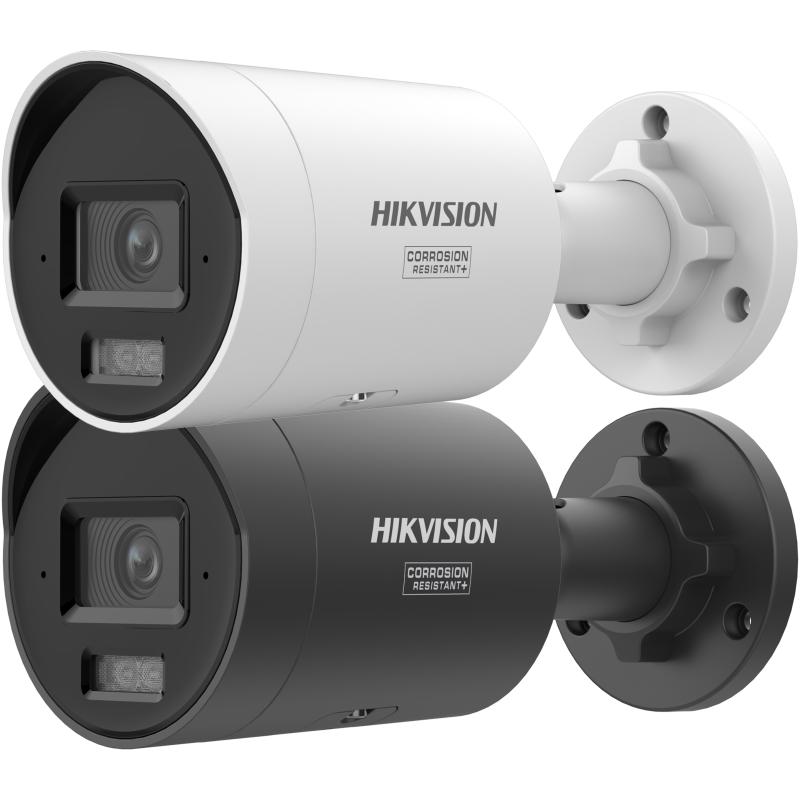
Hikvision replaced the DS-2CD2047G2H-LIU with this camera and changed one character in the model number. That understates it. Four things moved, and one of them decides whether the camera should go on a coastal building at all.
The headline is corrosion. The outgoing G2H sat in Hikvision’s lowest anti-corrosion class — the datasheet says plainly that it is for sites where no specific protection is needed. This one is rated NEMA 4X, which covers coastal areas roughly two kilometres inland and places that see acid rain. Same money, same shape, materially different lifespan near salt.
The rest is straightforwardly better: 0.0001 lux instead of 0.0005 at the same F1.0, a lens that sees 111° instead of 104° at 2.8 mm, arrayed dual microphones, defog and distortion correction added to the image pipeline, and a PoE draw that fell to 6.5 W.
- ColorVu at 0.0001 lux, F1.0, 1/1.8″ sensor, HikAI-ISP
- Smart Hybrid Light: infrared and white light, three supplement-light modes
- NEMA 4X anti-corrosion — the upgrade the previous generation did not have
- 4 MP, 2688 × 1520; 2.8 mm at 111.1° or 4 mm at 95.2°
- 130 dB scene-adaptive WDR, EIS, defog, distortion correction
- Supplement light to 40 m, infrared at 850 nm
- Arrayed dual-microphone; no speaker and no alarm terminals
- All-metal, IP67, 530 g, PoE 802.3af Class 3, max 6.5 W
What changed from the G2H
Both datasheets are public, so this is a comparison rather than a claim.
| DS-2CD2047G2H-LIU | DS-2CD2047G3-LI2UY | |
| Anti-corrosion | None — “no specific protection” | NEMA 4X, moderate protection |
| Min. illumination | 0.0005 lux colour | 0.0001 lux colour |
| Horizontal FOV at 2.8 mm | 104.0° | 111.1° |
| Horizontal FOV at 4 mm | 89.2° | 95.2° |
| Microphone | Single | Arrayed dual |
| Image enhancement | BLC, HLC, 3D DNR | Plus defog, distortion correction, EIS |
| PoE draw | Max 7 W | Max 6.5 W |
| ONVIF | Profile S/G/T | Profile S/G/T |
One oddity worth knowing before you design around it. Hikvision publishes identical DORI figures for both cameras — 61 m detect, 24 m observe, 12 m recognise, 6 m identify at 2.8 mm — even though the G3 spreads the same four megapixels across seven more degrees of scene. A wider lens normally costs recognition distance. Both sets are the manufacturer’s own published numbers and both are reproduced here as published; we have not recalculated them, and neither should a specification that has to stand up later.
The Smart Hybrid Light works on the principle the name describes: infrared while the scene is quiet, white light when the camera classifies a person or a vehicle, so the light is triggered by deep-learning classification rather than by motion. The G3 datasheet lists three supplement-light modes and does not name them, where the previous generation documented four. If a customer needs the exact mode behaviour written into a specification, confirm it against current Hikvision documentation — the mechanism is explained at length on the DS-2CD2047G2H-LIU page, but the mode list there belongs to that model.
What this camera actually covers
The lens is fixed and chosen at order. Switch between the two below: the 4 mm trades sixteen degrees of width for fourteen metres of detection range.
Read the result against the 40 m supplement light. At either focal length the detection distance runs past what the light reaches, so on an unlit site 40 m is the honest working edge after dark. Every angle and distance here is the manufacturer’s.
Loading the coverage diagram…
Full specification
Imaging, lens and DORI
| Image sensor | 1/1.8″ progressive scan CMOS |
| Max. resolution | 2688 × 1520 |
| Min. illumination | Colour 0.0001 lux (F1.0, AGC on); 0 lux with light |
| Shutter time | 1 s to 1/100,000 s |
| Day & night | IR cut filter |
| Angle adjustment | Pan 0° to 360°, tilt 0° to 90°, rotate 0° to 360° |
| Lens | Fixed focal, 2.8 mm or 4 mm, M16 mount, fixed iris, F1.0 |
| Focal length & FOV | 2.8 mm: horizontal 111.1°, vertical 57.6°, diagonal 138.5° 4 mm: horizontal 95.2°, vertical 48.3°, diagonal 117.4° |
| Depth of field | 2.8 mm: 2.5 m to ∞; 4 mm: 3.1 m to ∞ |
| DORI at 2.8 mm | D 61 m, O 24 m, R 12 m, I 6 m |
| DORI at 4 mm | D 75 m, O 30 m, R 15 m, I 7 m |
| Supplement light | White light and infrared, up to 40 m, smart supplement light, 850 nm, three modes |
| WDR | 130 dB, scene-adaptive |
| SNR | ≥ 52 dB |
| Image enhancement | BLC, HLC, 3D DNR, distortion correction, defog |
| Image stabilisation | EIS |
| Day / night switch | Day, night, auto, schedule |
| Privacy mask | 4 programmable polygon masks |
Video and audio
| Main stream | 50 Hz: 25 fps; 60 Hz: 30 fps (2688×1520, 1920×1080, 1280×720) |
| Sub-stream | 50 Hz: 25 fps; 60 Hz: 30 fps (1280×720, 640×480, 640×360) |
| Third stream | 10 fps at 1920×1080 and below, under certain settings |
| Video compression | Main: H.265+, H.265, H.264+, H.264; sub: H.265, H.264, MJPEG; third: H.265, H.264 |
| Video bit rate | 32 Kbps to 8 Mbps |
| H.264 / H.265 profile | Baseline, main, high / main |
| Bit rate control | CBR, VBR |
| SVC | H.264 and H.265 encoding |
| Region of interest | 1 fixed region on the main stream |
| Microphone | Arrayed dual-microphone |
| Audio compression | G.711, G.722.1, G.726, MP2L2, PCM, MP3, AAC-LC |
| Audio sampling | 8 / 16 / 32 / 48 kHz, with environment noise filtering |
| Speaker | None — no audio output and no alarm terminals |
Network and interfaces
| Ethernet | 1 RJ45 10M/100M self-adaptive |
| API | ONVIF Profile S, G and T; ISAPI; SDK; ISUP |
| Simultaneous live view | Up to 6 channels |
| Network storage | NAS (NFS, SMB/CIFS), auto network replenishment (ANR) |
| On-board storage | microSD/microSDHC/microSDXC up to 512 GB |
| Users | Up to 32, three levels: administrator, operator, user |
| Security | HTTPS, 802.1X (EAP-TLS, EAP-LEAP, EAP-MD5), TLS 1.1/1.2/1.3, IP address filter, watermark, security audit log, MAC host authentication |
| Client | iVMS-4200, Hik-Connect, Hik-Central |
| Browser | Plug-in free live view on Chrome 80+, Firefox 80+, Edge 89+ |
| Reset key | Yes |
Analytics and events
| Basic event | Motion detection with human and vehicle target classification, video tampering, exception |
| Smart event | Scene change detection |
| Face capture | Yes |
| Perimeter protection | Line crossing, intrusion, region entrance and exiting, triggered by human and vehicle targets |
| Linkage | Upload to FTP, NAS or memory card; notify surveillance centre; trigger recording and capture; email |
Power, housing and approvals
| Power | 12 VDC ±25%, 0.4 A, max. 4.8 W, Ø5.5 mm coaxial plug with reverse polarity protection; PoE IEEE 802.3af, Class 3, max. 6.5 W |
| Material | Front cover, body and bracket all metal |
| Dimensions | Ø74.4 mm × 176.3 mm |
| Weight | Approx. 530 g |
| Operating conditions | -30 °C to 60 °C, humidity 95% or less non-condensing |
| Protection | IP67 (IEC 60529-2013); no IK rating quoted |
| Anti-corrosion | NEMA 4X (NEMA 250-2018) — Hikvision’s moderate protection class, rated for coastal areas about 2 km inland and for acid rain |
| EMC | CE-EMC, RCM, IC, KC |
| Safety | UL 62368-1, CB (IEC 62368-1), CE-LVD |
| Environment | CE-RoHS |
The datasheet used here lists one order code, DS-2CD2047G3-LI2UY(2.8mm)(BLACK), so confirm availability before quoting a black 4 mm. The white camera takes either lens. DS-2CD2047G3-LI is the same camera without the microphone, and the /SL variant adds a strobe and speaker for active deterrence. Also written DS-2CD2047G3-LI(2U)Y. For a motorised varifocal with a strobe and speaker instead of hybrid light, see the DS-2CD2046G3-IZ2UY/SL; for the model this one replaces, see the DS-2CD2047G2H-LIU. Specification sourced from the manufacturer datasheet, DS-2CD2047G3-LI2UY, 5 January 2026.
Works with SmartGard.AI
The camera makes exactly one decision on its own: is that shape a person or a vehicle. That decision is what turns the white light on, and it is genuinely useful. It is also the entire extent of what the camera understands. It cannot tell a delivery driver from a stranger, and it does not know that the same figure at three in the afternoon and three in the morning mean different things.
SmartGard.AI needs one thing from a camera: the ability to say that something happened. This one reports motion with human and vehicle classification, line crossing, intrusion, region entrance and exiting, face capture, scene change and tampering. When a trigger arrives, the frames from that event are read against zone rules written in plain language, and the system decides whether anybody needs to hear about it.
The hybrid light matters here for a practical reason: the frame that arrives is in colour rather than infrared grey, which is a better thing to reason over. Clothing, vehicle colour and detail survive.
Two honest limits. Each event is judged on its own — there is no correlation between cameras, so a figure crossing three fields of view is three separate judgements, not one tracked path. And nothing is watched continuously: analysis runs when an event fires or when a patrol is requested from the app. This is a layer that decides what deserves your attention, not a monitored alarm system with a receiving centre behind it.
Already have cameras up? The same layer retrofits onto most modern IP installations without replacing what you already own.