
Hikvision DS-7608NXI-K2/8P(E) — 8-Channel AcuSense 4K NVR
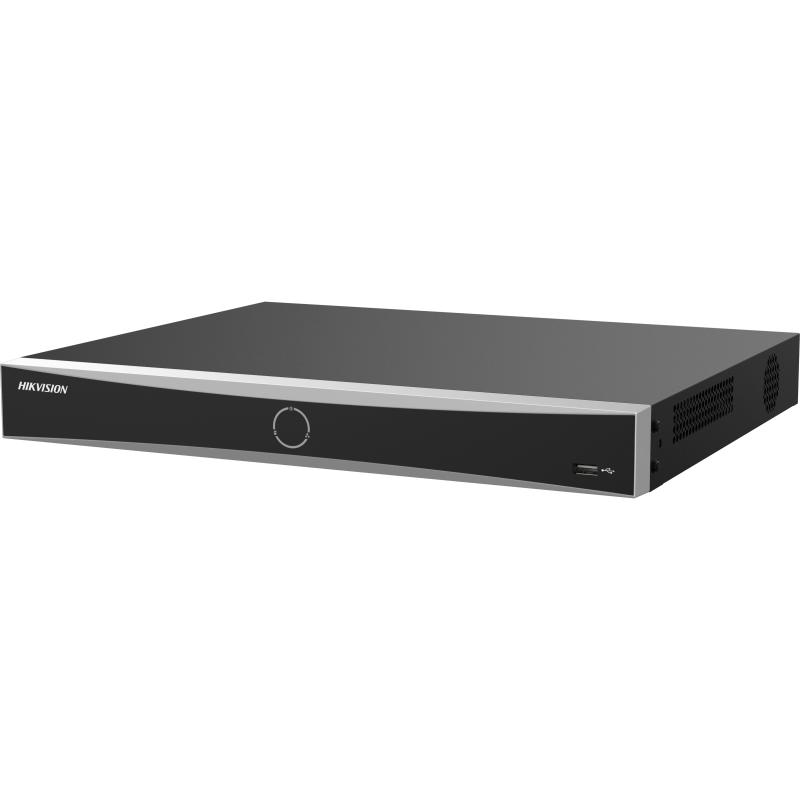
This is the recorder most eight-camera jobs end up with, and for once the popular choice is the sensible one.
The feature worth paying for is AcuSense running on the recorder. Cameras that are too old or too cheap to classify anything themselves send their motion events here, and the NVR decides whether the thing that moved was a person, a vehicle or a branch. That is the single biggest reduction in nuisance alerts available to an existing installation, and it does not require replacing a single camera.
It should be said plainly that the recorder’s own AI is not unlimited: perimeter protection by NVR covers two channels at up to 4 MP, or one at 5 to 8 MP. The rest of your channels can still run analytics, but they have to do it in the camera. Plan which two matter most, or buy cameras that think for themselves and let the recorder do what recorders do.
- 8 channels with 8 built-in PoE ports, 80 W total budget
- AcuSense on the recorder — human and vehicle filtering for cameras that cannot
- AcuSearch across all channels where the camera supports it
- Face comparison on 8 channels, 16 libraries, 50,000 pictures
- 80 Mbps in, 160 Mbps out — generous headroom for remote viewing
- 2 SATA bays, up to 16 TB per drive
- 4K HDMI plus independent VGA, 8-channel synchronous playback
- Gigabit network port, 4 alarm inputs, 1 output, ≤ 15 W without drives
What actually fits on this recorder
“Eight channels” is the number on the box. It is not the number that limits you. Three others do, and nobody mentions them until something does not work.
Bandwidth. Incoming is capped at 80 Mbps, which is 10 Mbps per channel if you fill it. Eight 4 MP cameras in H.265 at 25 fps typically want 4 to 6 Mbps each — roughly 48 Mbps, comfortable. Eight 8 MP cameras at good quality can want 8 to 12 Mbps each, which is 96 Mbps and over the limit. The recorder will not refuse them; the picture quality will quietly drop instead.
PoE budget. Eight ports share 80 W, so 10 W each on average. Standard 802.3af cameras fit easily. Cameras that want 802.3at at 25 W — the panoramic and PTRZ models in this catalogue — will exhaust the budget after three, and the rest need injectors or a separate switch.
Storage. Two bays at 16 TB gives 32 TB. As a worked example: eight cameras averaging 6 Mbps produce about 520 GB a day, so roughly two months of continuous recording. Halve the bitrate or record on motion and that stretches considerably.
None of this is a criticism of the recorder. It is the arithmetic every quote should contain and most do not.
Full specification
Intelligent analytics
| AI by NVR | Facial recognition, perimeter protection, motion detection 2.0, AcuSearch |
| AI by camera | Facial recognition, perimeter protection, motion detection 2.0, ANPR |
| AcuSearch by camera | All channels, where the camera has AcuSearch enabled |
| Perimeter protection by NVR | Up to 4 MP: 2 channels; 5 to 8 MP: 1 channel |
| Perimeter protection by camera | All channels |
| Motion detection 2.0 by NVR | All channels up to 4 MP, or up to 8 MP with enhanced SVC mode |
| Facial detection performance | Up to 4 MP: 2 channels; 5 to 8 MP: 1 channel |
| Face picture comparison | 8 channels |
| Face picture library | Up to 16 libraries, 50,000 pictures total, each up to 1 MB |
Video, audio and decoding
| IP video input | 8 channels |
| IP speaker input | 4 channels |
| Incoming bandwidth | 80 Mbps |
| Outgoing bandwidth | 160 Mbps |
| Video output | Independent HDMI and VGA |
| HDMI output | 4K (3840×2160)/30 Hz, 2K/60 Hz, 1920×1080/60 Hz and below |
| VGA output | 1920×1080/60 Hz and below |
| Audio | 1 output RCA; 1 two-way audio channel |
| Decoding format | H.265/H.265+/H.264/H.264+ |
| Recording resolution | 16 MP down to QCIF (16 MP on channel 1 only) |
| Decoding, AI on | 2×12 MP@30fps, 4×8 MP@30fps, 5×6 MP@30fps, 8×4 MP@30fps |
| Decoding, AI off | 3×12 MP@30fps, 5×8 MP@30fps, 6×6 MP@30fps, 8×4 MP@30fps |
| Synchronous playback | 8 channels |
| Audio compression | G.711ulaw, G.711alaw, G.722, G.726, AAC, MP2L2 |
Network, PoE and interfaces
| Network interface | 1 RJ-45 10/100/1000 Mbps self-adaptive |
| Protocols | TCP/IP, DHCP, IPv4, IPv6, DNS, DDNS, NTP, RTSP, SADP, SMTP, SNMP, NFS, iSCSI, ISUP, UPnP, HTTP, HTTPS |
| API | ONVIF (Profile S/G), SDK, ISAPI |
| Remote connections | 128 |
| Browsers | IE 11, Chrome 91+, Firefox 88+, Safari 12+, Edge 91+ |
| PoE ports | 8 RJ-45 10/100 Mbps self-adaptive |
| PoE power | ≤ 80 W total, IEEE 802.3af/at |
| SATA | 2 interfaces, up to 16 TB per drive |
| Alarm in / out | 4 / 1 |
| USB | Front: 1× USB 2.0; rear: 1× USB 2.0 |
Power, housing and approvals
| Power supply | 48 VDC, 2.5 A |
| Consumption | ≤ 15 W without drives |
| Cooling | Fan fitted |
| Dimensions | 384 × 317 × 52 mm |
| Weight | ≤ 2 kg without drives |
| Working conditions | -10 °C to 55 °C, humidity 10% to 90% |
| Certification | CE, CB, REACH, WEEE, UKCA, RCM, IC |
| Interface languages | English, Polish, German, French, Italian, Czech, Dutch and more |
Also listed as DS-7608NXI-K2/8P(E) and DS-7608NXI-K2-8P-E. The Pro Series runs to 34 models across K1 and K2 tiers in 4, 8, 16 and 32-channel versions, with and without PoE. For plain-English search across recorded footage, see the DS-7608NXI-K1/8P/VPro; for a 32-channel enterprise recorder, the iDS-7732NXI-M4/16P/X. Specification sourced from the manufacturer product page.
Works with SmartGard.AI
SmartGard.AI does not read from your recorder, replace it, or interfere with it. This NVR keeps recording exactly as it does now, on your retention policy, and the footage stays where it is and stays yours. The system sits alongside it and works from what the cameras report.
The two do different jobs and the difference is worth being clear about. The recorder decides whether something moved and roughly what shape it was. SmartGard.AI decides whether it mattered — against the zones you described in your own words, at this hour, on this site. AcuSense on the NVR removes the branches; the judgement layer removes the deliveries, the neighbour’s cat and the contractor who is supposed to be there.
Already have this recorder installed? That is the normal case. The layer retrofits onto most modern IP installations without replacing what you already own.