
Virtual Patrol
A full round of your site, on demand, with a written report at the end. Nobody leaves their chair.
The guard walking the rounds
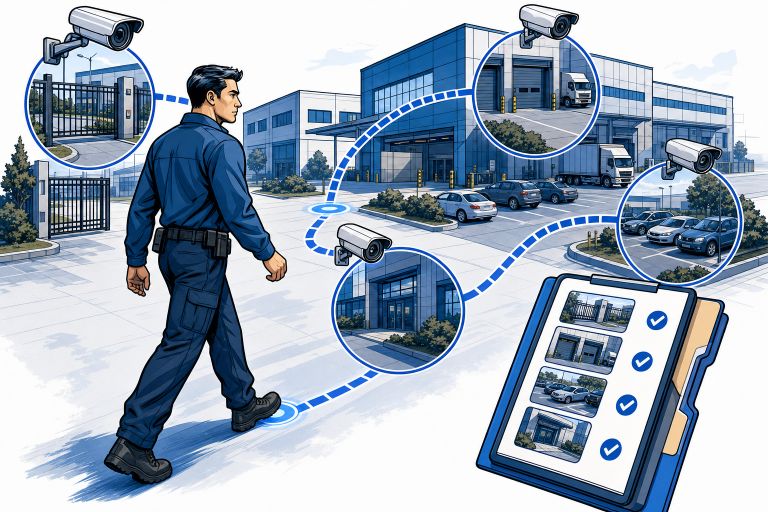
The other half of a guard’s job is not sitting at a screen. It is walking the site with a checklist – gates, doors, the yard, the bays – and writing up what they found.
That round is valuable and it is expensive, which is why on most sites it happens less often than anyone would like. SmartGard.AI does it without anyone walking anywhere, and it does it as often as you want.
On demand or on schedule
Tap a button, and the round starts.
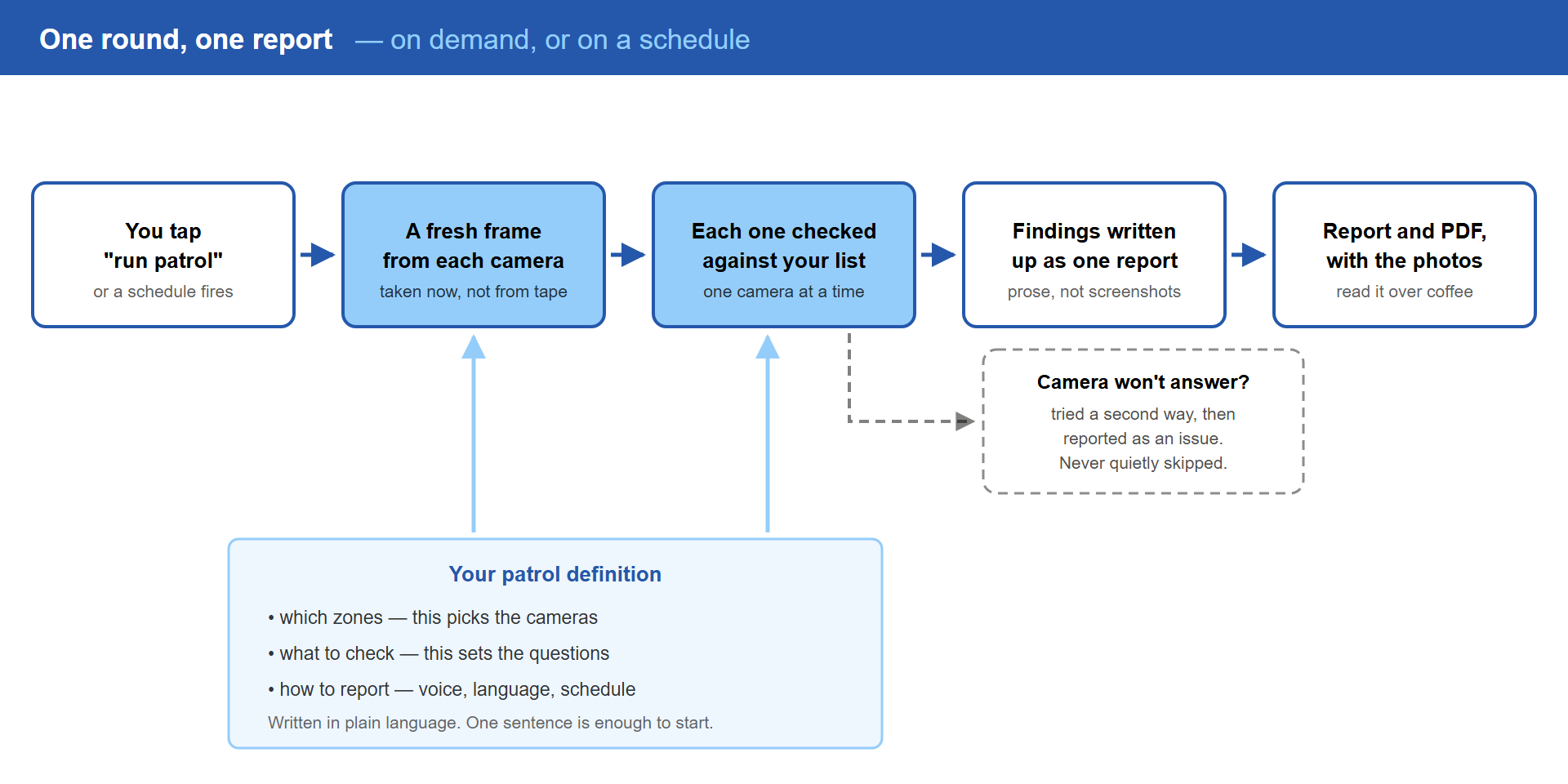
SmartGard.AI captures a fresh image from every camera in the zones you selected – not a still pulled from old footage, a picture taken now – and inspects each one against the instructions you wrote:
“Check that the gates are closed. No vehicles outside the marked bays. No water on the warehouse floor. Nothing blocking the fire exits.”
You can also set a schedule and forget about it. A round every night at eleven, one at six in the morning before the first shift arrives, one every hour through a bank holiday weekend. The report is waiting when you want it.
A written report, not a pile of screenshots
What you get back is not forty images to click through. It is one report.
Per-camera observations, written in prose. Anything that looks wrong flagged as an issue. The photographs attached to the findings they belong to. A PDF ready to file, forward, or hand to whoever asks.
Reviewing a night’s patrol takes a minute over coffee, rather than an hour of scrubbing footage hoping you notice the thing you are looking for.
Click the diagram to enlarge
Reports in your style
By default your reports are written by a straight-laced professional security guard, which is what most people want most of the time.
If your mornings need something else, pick a different voice – a military officer, an old-school detective, a news anchor. Same facts, same findings, different delivery. It is a small thing, and it is remarkable how much more often a report gets read when it is not written like a form.
Reports come in English, or in the language you wrote your instructions in.
It checks the cameras too
A patrol is also a health check on your CCTV, and this is the part people do not expect to value until it saves them.
Every camera on the route has to actually produce a frame. SmartGard.AI tries two separate capture routes before it gives up on one. A camera that cannot be reached is not quietly skipped and it is not silently dropped from the report – it appears as an issue, and the patrol itself is flagged as completed with problems.
Which means you find out about a dead camera from a routine round on a quiet Tuesday, rather than from the incident it failed to record.
It knows what happened here recently
A patrol can be told to bring recent history with it.
Switch it on, and the round does not only assess what the cameras show right now – it also takes in what those same cameras reported over a recent window, optionally only the events that raised alarms. The window is yours to set.
The difference in the report is stark. Without it: “The side gate is closed.” With it: “The side gate is closed, though someone was standing at it for several minutes two hours ago.”
The first is a status. The second is something you would want to know.
It is switched on per patrol definition, and it costs a little extra – reading and summarising that history is additional work for the AI, so it is billed as such. Worth it on the rounds where context matters, and easy to leave off on the ones where it does not.
Set it up by describing it
You do not have to build a patrol out of form fields.
Describe it in a sentence – “check the car park and the main entrance every hour after 8 pm” – and the assistant drafts the whole definition: which zones, what schedule, what the round should be looking for. Where the sentence is ambiguous it asks, exactly as a new guard would ask before walking an unfamiliar route for the first time.
You review the draft, adjust anything that is not right, and it is ready.
What people use patrols for
Closing time. After the last shift leaves. Has everyone actually gone, are the loading gates down, are the doors shut, is anything still parked in the yard?
Opening check. Before staff arrive. Is everything as it was left, are the entrances clear, did anything change overnight?
After-hours rounds. Scheduled night patrols of the perimeter and the zones that matter, with a report waiting in the morning instead of a night’s worth of footage nobody will watch.
Compliance walks. Fire exits unobstructed, forklifts parked in their bays, no pallets in the escape routes. The kind of check that is easy to promise and hard to evidence – until it produces a dated PDF every week.
After the storm. One tap, and the whole site is checked for damage, standing water, or anything out of place. Without anyone driving there on a Sunday.
Frequently asked questions
How long does a patrol take?
It depends on how many cameras are on the route, since each one is captured and assessed in turn. A handful of cameras is quick. You can watch the progress in the app rather than guessing, and the report appears when the round is finished.
What if a camera is offline?
It is tried twice, by two different routes, and if it still cannot be reached it goes into the report as an issue. The patrol carries on and reports on everything else – one unreachable camera does not cost you the whole round.
Can I schedule one for every night?
Yes, on whatever pattern you need, in your site’s time zone. Nightly, twice nightly, weekdays only, or every hour across a shutdown period.
Who can order a patrol?
Anyone with the appropriate role on the site. Members hold roles – owner, admin, user, guest – and what each can do follows from that.
Does a patrol raise alarms?
No. A patrol produces a report. If it finds something that needs immediate attention, that is in the report and flagged as an issue – but the alerting path is AI Alarm Verification, and the two are separate on purpose.
Does it cost more than event analysis?
A patrol costs what it analyses: one assessment per camera on the route, plus writing the report. A round of six cameras costs roughly what you would expect six analyses to cost. Usage is visible per patrol in the app.