
Hikvision DS-2CD2T46G2H-2I/4I — 4 MP AcuSense DarkFighter Bullet
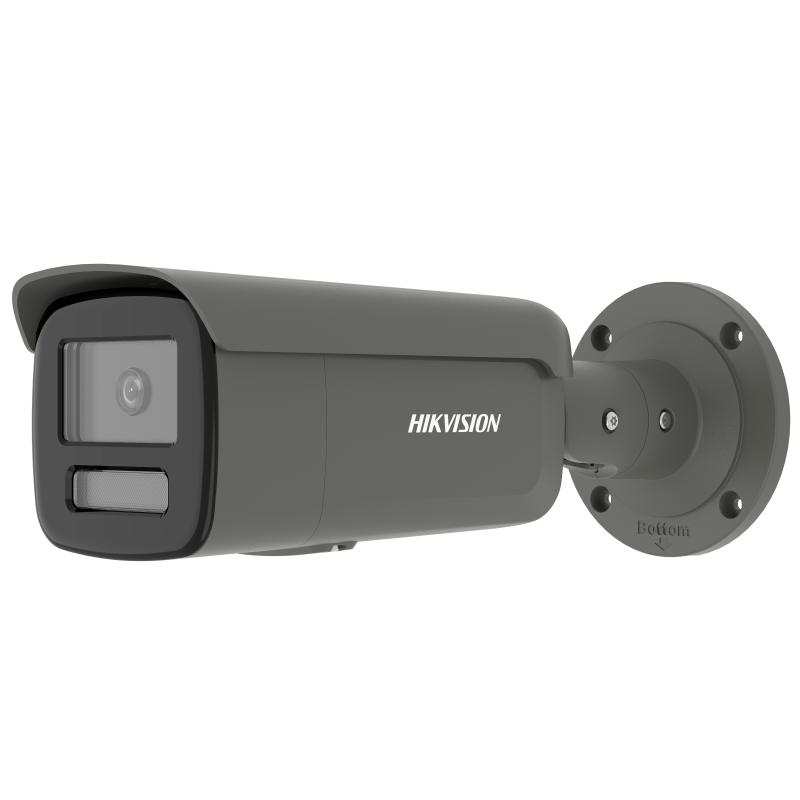
Every catalogue needs one camera that is simply the sensible answer, and on a great many jobs this is it. A 4 MP bullet, a metre of cable, a bracket, done.
What lifts it above ordinary is the glass. The aperture is a constant F1.0 — not F1.4, not F1.6, and not a figure that quietly worsens as the lens moves, because the lens does not move. Behind it sits DarkFighter processing, and the two together produce 0.001 lux in colour. That is several times more light-sensitive than the mini domes elsewhere in this series, and it is the difference between a usable colour picture under a car park lamp and a grainy monochrome one.
Then 60 metres of infrared for when there is no light at all, 120 dB true wide dynamic range for the gateway that faces the afternoon sun, and a body that is metal all the way through — front cover, casing and bracket — with stainless screws. It weighs a little over a kilogram, so give it something solid to sit on.
- 0.001 lux in colour at a constant F1.0, powered by DarkFighter
- Infrared to 60 m (-2I) or 80 m (-4I), 850 nm, smart supplement light
- 4 MP, 2688 × 1520, 120 dB true WDR, SNR ≥ 52 dB
- Fixed 2.8 mm or 4 mm, 100.2° or 81.1° horizontal
- AcuSense with line crossing, intrusion, region entrance and exiting
- Face capture and scene change detection
- All-metal housing, SUS304 screws, IP67, -30 °C to 60 °C
- PoE 802.3af, max 9 W, microSD to 512 GB, 1085 g
Two variants: -2I and -4I
This model number ships in two builds and exactly one thing separates them: how far the infrared throws. Sensor, lens options, DORI distances, the F1.0 aperture, wide dynamic range, analytics, housing and ratings are identical.
| DS-2CD2T46G2H-2I | DS-2CD2T46G2H-4I | |
| Infrared range | Up to 60 m | Up to 80 m |
| Infrared LEDs | 2 | 4 |
| PoE consumption | Max. 9 W | Max. 12 W |
| 12 VDC consumption | Max. 7.2 W | Max. 10 W |
| Everything else | Identical | Identical |
Both builds take either lens, so there are four order codes: -2I and -4I, each in 2.8 mm and 4 mm.
How to choose. Match the illuminator to the lens rather than to the budget. At 2.8 mm the camera detects to 63 m, so the -2I’s 60 m is already balanced and the -4I buys almost nothing. At 4 mm detection runs to 78 m, and there the -2I leaves the last eighteen metres unlit while the -4I covers the whole range. The other consideration is the switch: three extra watts per port adds up across a full rack.
What this camera actually covers
The lens is fixed and chosen at order, so switch between the two below before you decide. The 4 mm surrenders nineteen degrees of width and returns fifteen metres of detection range.
There is a second limit the drawing cannot show, and on this model it is the one that decides which variant you buy. On the -2I, infrared reaches 60 metres. At the 2.8 mm setting that sits almost exactly on the 63 metre detection figure, which is a well-balanced camera. At 4 mm, detection runs to 78 metres while the illuminator still stops at 60 — so after dark, on an unlit site, the last eighteen metres of that range exist only on paper. Every angle and distance here is the manufacturer’s.
Loading the coverage diagram…
Full specification
Imaging, lens and DORI
| Image sensor | 1/3″ progressive scan CMOS |
| Max. resolution | 2688 × 1520 |
| Min. illumination | Colour 0.001 lux (F1.0, AGC on); B/W 0 lux with IR |
| Shutter time | 1/3 s to 1/100,000 s |
| Day & night | IR cut filter |
| Angle adjustment | Pan 0° to 360°, tilt 0° to 90°, rotate 0° to 360° |
| Lens | Fixed focal, 2.8 mm or 4 mm, M12 mount, fixed iris |
| Aperture | Constant F1.0 |
| Focus control | Auto; ABF and blue glass module not supported |
| Focal length & FOV | 2.8 mm: horizontal 100.2°, vertical 54.7°, diagonal 119.7° 4 mm: horizontal 81.1°, vertical 44.7°, diagonal 94.6° |
| Depth of field | 2.8 mm: 1.9 m to ∞; 4 mm: 2.5 m to ∞ |
| DORI at 2.8 mm | D 63 m, O 25 m, R 12 m, I 6 m |
| DORI at 4 mm | D 78 m, O 31 m, R 15 m, I 7 m |
| Supplement light | Infrared, 850 nm, smart supplement light. -2I: 2 LEDs, up to 60 m; -4I: 4 LEDs, up to 80 m |
| WDR | 120 dB true WDR |
| SNR | ≥ 52 dB |
| Image enhancement | BLC, HLC, 3D DNR |
| Day / night switch | Day, night, auto, schedule |
| Privacy mask | 4 programmable polygon masks |
Video and streams
| Main stream | 50 Hz: 25 fps; 60 Hz: 30 fps (2688×1520, 1920×1080, 1280×720) |
| Sub-stream | 50 Hz: 25 fps; 60 Hz: 30 fps (1280×720, 640×480, 640×360) |
| Third stream | 10 fps (1920×1080 down to 640×360), supported under certain settings |
| Video compression | Main: H.265/H.264/H.265+/H.264+; sub: H.265/H.264/MJPEG; third: H.265/H.264 |
| Video bit rate | 32 Kbps to 8 Mbps |
| H.264 / H.265 profiles | Baseline, Main, High / Main |
| Bit rate control | CBR / VBR |
| SVC | H.264 and H.265 encoding |
| ROI | 1 fixed region for main and sub-stream |
Network and interfaces
| Ethernet | 1 RJ45 10M/100M self-adaptive |
| Protocols | TCP/IP, ICMP, HTTP, HTTPS, FTP, DHCP, DNS, DDNS, RTP, RTSP, NTP, UPnP, SMTP, IGMP, 802.1X, QoS, IPv4, IPv6, UDP, Bonjour, SSL/TLS, PPPoE, SNMP, ARP, WebSockets |
| API | ONVIF (Profile S, G and T), ISAPI, SDK |
| Simultaneous live view | Up to 6 channels |
| Users | Up to 32, three levels: administrator, operator, user |
| Security | Password protection, HTTPS encryption, IP address filter, security audit log, TLS 1.1/1.2, WSSE and digest authentication |
| Network storage | NAS (NFS, SMB/CIFS), ANR; memory card encryption and health detection with high-end Hikvision cards |
| On-board storage | microSD/microSDHC/microSDXC up to 512 GB |
| Audio and alarm | None — no microphone, speaker, audio interface or alarm I/O on this model |
| Reset key | Yes |
| Client | iVMS-4200, Hik-Connect, Hik-Central |
Analytics and events
| Basic event | Motion detection with human and vehicle target classification, video tampering, exception |
| Smart event | Scene change detection |
| Face capture | Yes |
| Perimeter protection | Line crossing, intrusion, region entrance and exiting, triggered by human and vehicle targets |
| Linkage | Upload to NAS, memory card or FTP; notify surveillance centre; trigger recording and capture; email |
Power, housing and approvals
| Power (-2I) | 12 VDC ±25%, 0.6 A, max. 7.2 W, Ø5.5 mm coaxial plug with reverse polarity protection; PoE IEEE 802.3af, Class 3, max. 9 W |
| Power (-4I) | 12 VDC ±25%, 0.83 A, max. 10 W; PoE IEEE 802.3af, Class 3, max. 12 W |
| Material | Front cover, body and bracket all metal; SUS304 screws |
| Dimensions | 286.7 × 93.1 × 91.2 mm |
| Weight | Approx. 1085 g |
| Operating conditions | -30 °C to 60 °C, humidity 95% or less non-condensing |
| Protection | IP67 (IEC 60529-2013); no IK rating quoted |
| Anti-corrosion | None — the datasheet places this model in Hikvision’s “no specific protection” class, so not for coastlines, docks or chemical plants |
| EMC | CE-EMC (EN 55032, EN 50130-4, EN IEC 61000-3-2, EN 61000-3-3) |
| Safety | UL 62368-1, CB (IEC 62368-1), CE-LVD |
| Environment | CE-RoHS |
Available as DS-2CD2T46G2H-2I(2.8mm) and (4mm), with a grey finish option, and as DS-2CD2T46G2H-4I in the same two lenses where 80 m of infrared is wanted. Also written DS-2CD2T46G2H-2I and DS-2CD2T46G2H2I. If you need audio or alarm terminals, the DS-2CD2546G2-IS(C) mini dome has them; for an indoor recessed alternative see the DS-2CD2E43G2-U. Specification sourced from the manufacturer datasheet, DS-2CD2T46G2H-2I/4I, 13 May 2024.
Works with SmartGard.AI
A camera this good in the dark changes what reaches you at night. Where a lesser bullet gives up and stops reporting, this one keeps seeing — and keeps reporting. That is the point of buying it, and also the reason the alerts need filtering rather than forwarding.
The system needs one thing from a camera: the ability to report that something happened. This one reports motion with human and vehicle classification, line crossing, intrusion, region entrance and exiting, face capture, scene change and tampering. SmartGard.AI reads the frame each trigger arrives with and judges it against rules written in your own words, so a person crossing the yard at two in the morning and the same person doing it at two in the afternoon stop arriving as the same message.
Worth noting for this model in particular: with no audio and no alarm terminals, everything the camera has to say arrives over the network as an event. There is no siren to wire and no contact to loop in, which makes the judgement layer the only place where the filtering can happen.
Already have cameras up? The same layer retrofits onto most modern IP installations without replacing what you already own.