
Hikvision DS-2CD2546G2-IS(C) — 4 MP AcuSense EXIR Mini Dome
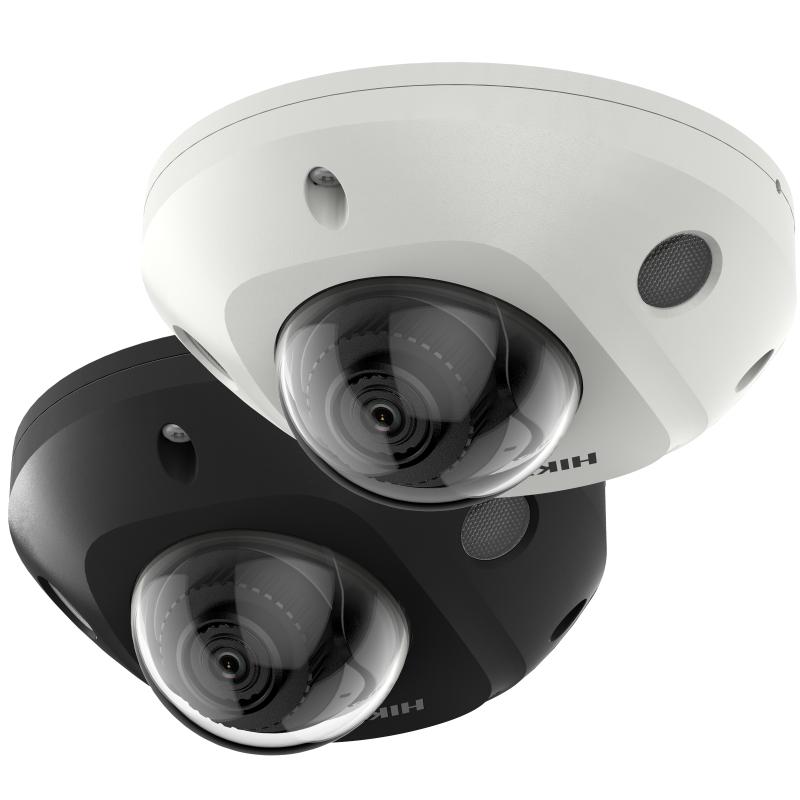
Fifty-seven millimetres. That is how far this camera stands off the surface it is fixed to, on a body 110 mm across, and it is the whole reason to choose it: a camera that survives outdoors without announcing itself from the other side of the car park.
Nothing has been given up for the shape. It carries EXIR to 30 metres, so it works in genuine darkness rather than merely dim conditions. It is sealed to IP67 and rated IK08, which is five joules of impact — a solid kick rather than a sledgehammer, and enough for a doorway or a corridor where the IK10 models in this catalogue would be over-specified. It runs from -30 °C. The base is aluminium under a plastic cover, and the whole thing weighs 380 grams on 6.5 watts of ordinary 802.3af PoE.
The suffix matters when you order. The -S adds what the plain -I model omits: a line in and a line out on terminal blocks, plus one alarm input and one alarm output. If you want the camera wired to a door contact, a beam or a sounder, that is the letter you are paying for. There is also a black finish in the 2.8 mm variant.
- Only 57.4 mm deep, Ø110 mm, 380 g, white or black
- EXIR to 30 m at 850 nm with smart supplement light
- 0.003 lux in colour at F1.4; 0 lux with infrared
- 4 MP, 2688 × 1520, 120 dB WDR, SNR ≥ 52 dB
- Fixed 2.8 mm or 4 mm, 102.7° or 82.8° horizontal
- -S adds audio in and out plus 1 alarm input and 1 output
- Face capture, line crossing, intrusion, region entrance and exiting
- IP67 and IK08, -30 °C to 60 °C, PoE 802.3af, max 6.5 W
What this camera actually covers
The lens is chosen at order and cannot be changed afterwards, so this is the decision worth spending two minutes on. Switch between them below: the 4 mm trades twenty degrees of width for thirteen metres of extra detection range and two metres of extra identification.
Watch the second view as well. Mini domes tend to go up on a wall or under a soffit at around three metres, and at that height the blind zone underneath is small but real. Every figure here, horizontal and vertical, is the manufacturer’s. One limit the diagram does not draw: infrared reaches 30 m, so after dark that is the practical edge of usefulness regardless of what the detection figures promise in daylight.
Loading the coverage diagram…
Full specification
Imaging, lens and DORI
| Image sensor | 1/3″ progressive scan CMOS |
| Max. resolution | 2688 × 1520 |
| Min. illumination | Colour 0.003 lux (F1.4, AGC on); B/W 0 lux with IR |
| Shutter speed | 1/3 s to 1/100,000 s |
| Day & night | IR cut filter |
| Angle adjustment | Pan -30° to 30°, tilt 0° to 75°, rotate 0° to 360° |
| Lens | Fixed focal, 2.8 mm or 4 mm, M12 mount, fixed iris, F1.4 |
| Focal length & FOV | 2.8 mm: horizontal 102.7°, vertical 55.2°, diagonal 122.5° 4 mm: horizontal 82.8°, vertical 45.3°, diagonal 97.7° |
| Depth of field | 2.8 mm: 1.6 m to ∞; 4 mm: 2.1 m to ∞ |
| DORI at 2.8 mm | D 64 m, O 26 m, R 13 m, I 6 m |
| DORI at 4 mm | D 77 m, O 31 m, R 16 m, I 8 m |
| Supplement light | EXIR infrared up to 30 m, 850 nm, smart supplement light |
| WDR | 120 dB |
| SNR | ≥ 52 dB |
| Image enhancement | BLC, HLC, 3D DNR |
| Day / night switch | Day, night, auto, schedule |
Video and audio
| Main stream | 50 Hz: 25 fps; 60 Hz: 30 fps (2688×1520, 1920×1080, 1280×720) |
| Sub-stream | 50 Hz: 25 fps; 60 Hz: 30 fps (1280×720, 640×480, 640×360) |
| Third stream | 10 fps (1920×1080 down to 640×360), supported under certain settings |
| Video compression | Main: H.265/H.264/H.265+/H.264+; sub: H.265/H.264/MJPEG; third: H.265/H.264 |
| Video bit rate | 32 Kbps to 8 Mbps |
| H.264 / H.265 profiles | Baseline, Main, High / Main |
| Bit rate control | CBR / VBR |
| SVC | H.264 and H.265 encoding |
| ROI | 1 fixed region for main and sub-stream |
| Audio type | Mono, 2 channel or stereo |
| Audio compression | G.711/G.722.1/G.726/MP2L2/PCM/MP3 |
| Audio sampling rate | 8, 16, 32, 44.1 and 48 kHz |
| Noise filtering | Yes |
Network and interfaces
| Ethernet | 1 RJ45 10M/100M self-adaptive |
| Protocols | TCP/IP, ICMP, HTTP, HTTPS, FTP, DHCP, DNS, DDNS, RTP, RTSP, NTP, UPnP, SMTP, IGMP, 802.1X, QoS, IPv4, IPv6, UDP, Bonjour, SSL/TLS, PPPoE, SNMP, ARP, WebSockets |
| API | ONVIF (Profile S, G and T), ISAPI, SDK |
| Simultaneous live view | Up to 6 channels |
| Users | Up to 32, three levels: administrator, operator, user |
| Security | Password protection, HTTPS encryption, IP address filter, security audit log, TLS 1.1/1.2, WSSE and digest authentication |
| Network storage | NAS (NFS, SMB/CIFS), ANR; memory card encryption and health detection with high-end Hikvision cards |
| On-board storage | microSD card up to 512 GB |
| Built-in microphone | Yes |
| Audio interfaces | -IS: 1 line in and 1 line out on two-core terminal blocks, max. 3.3 Vpp |
| Alarm | -IS: 1 input, 1 output (max. 12 VDC, 20 mA) |
| Reset key | Yes |
| Client | iVMS-4200, Hik-Connect, Hik-Central |
Analytics and events
| Basic event | Motion detection with human and vehicle target classification, video tampering, exception |
| Smart event | Line crossing, intrusion, region entrance, region exiting, scene change detection |
| Face capture | Yes |
| Perimeter protection | Line crossing, intrusion, region entrance and exiting, triggered by human and vehicle targets |
| Linkage | Upload to FTP, NAS or memory card; notify surveillance centre; trigger recording and capture; email |
Power, housing and approvals
| Power | -IS: 12 VDC ±25%, 0.45 A, max. 5.5 W, Ø5.5 mm coaxial plug with reverse polarity protection; PoE IEEE 802.3af, Class 3, max. 6.5 W |
| Material | Aluminium base, plastic cover |
| Dimensions | Ø110 mm × 57.4 mm |
| Weight | Approx. 380 g |
| Operating conditions | -30 °C to 60 °C, humidity 95% or less non-condensing |
| Protection | IP67 (IEC 60529-2013), IK08 (IEC 62262:2002) |
| EMC | FCC (47 CFR Part 15 Subpart B), CE-EMC, RCM, IC, KC |
| Safety | UL 62368-1, CB (IEC 62368-1), CE-LVD, LOA |
| Environment | CE-RoHS, WEEE, REACH |
Available as DS-2CD2546G2-IS (2.8 mm and 4 mm), DS-2CD2546G2-IS (2.8 mm) in black, and DS-2CD2546G2-I without the audio and alarm terminals. Also written DS-2CD2546G2-IS(C) and DS-2CD2546G2-ISC, where (C) denotes the current hardware revision. For the same 4 MP AcuSense platform recessed into a ceiling for indoor use, see the DS-2CD2E43G2-U. Specification sourced from the manufacturer datasheet, DS-2CD2546G2-I(WS)-C, V5.5.115, which covers this model.
Works with SmartGard.AI
This camera goes where people actually walk: back doors, side alleys, delivery bays, the corner of a yard. Those are exactly the places where motion happens all day for entirely legitimate reasons, and where a camera left to alert on its own becomes a phone that buzzes every time the bins go out.
The system needs one thing from a camera: the ability to report that something happened. This one reports motion with human and vehicle classification, line crossing, intrusion, region entrance and exiting, face capture, scene change and tampering. SmartGard.AI reads the frame each trigger arrives with and judges it against rules written in your own words, so the delivery at nine and the same doorway at three in the morning stop being the same event.
The alarm terminals on the -S variant are worth mentioning here. A door contact or a beam wired into the input becomes another trigger, and the output can drive a sounder or a light — useful whether or not the judgement layer is involved.
Already have cameras up? The same layer retrofits onto most modern IP installations without replacing what you already own.