
Hikvision DS-2CD2E43G2-U — 4 MP AcuSense In-Ceiling Mini Dome
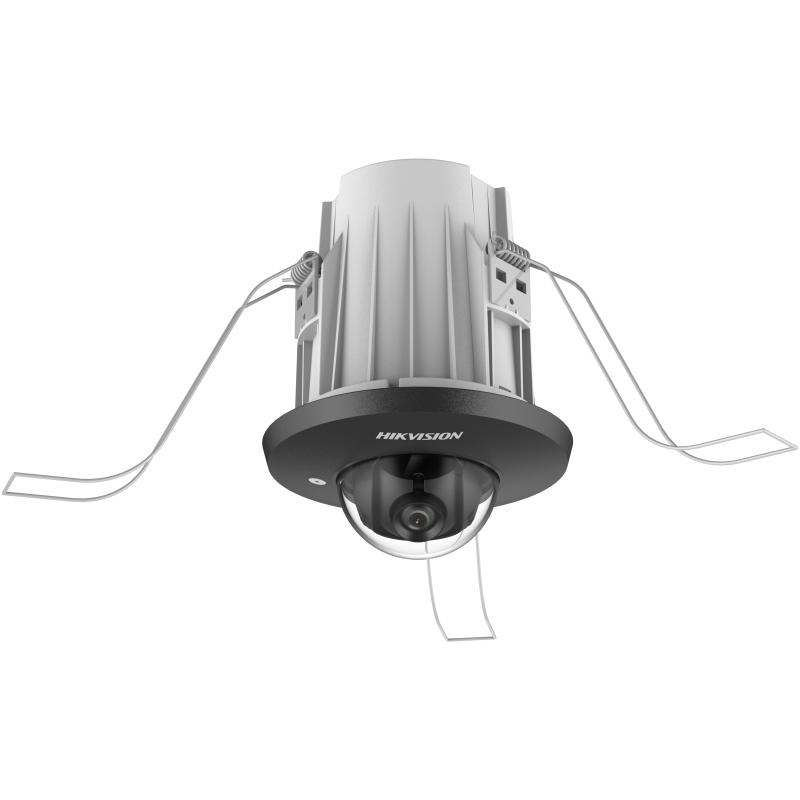
Some rooms are not improved by a camera bolted to the ceiling. Receptions, boardrooms, showrooms, consulting rooms — places where the point is that people feel comfortable, and a lump of white plastic on a bracket does the opposite.
This one goes into the ceiling. The body sits above the tile on sprung clips, the way a downlight does, and all that remains in the room is a bezel a little over nine centimetres across. It weighs 155 grams and draws 4.2 watts over ordinary 802.3af PoE, so nothing about installing it is a project.
One thing must be said before anything else, because the housing invites the mistake: this camera is indoor only. There is no infrared illuminator, no white light, no IP rating and no IK rating quoted anywhere in the specification, and it is rated from -10 °C. It needs a room with the lights on, or at least some ambient light — 0.005 lux is respectable, but it is not zero, and there is nothing on board to supply the difference. If the location is outdoors, a porch, a car park or an unlit store room, the DS-2CD2546G2-IS is the same idea with infrared and an IP67 shell.
- Recessed in-ceiling mount — only the Ø93.9 mm bezel shows
- 4 MP, 2688 × 1520 on a 1/3″ sensor, 120 dB WDR
- Fixed 2.8 mm or 4 mm, 103° or 84° horizontal, F1.6
- AcuSense human and vehicle classification, line crossing and intrusion
- Built-in microphone, microSD to 512 GB, face detection
- PoE 802.3af, max 4.2 W — 155 g, plastic body
- Indoor only: no illuminator, no IP or IK rating, -10 °C to 50 °C
- Ships as 2.8 mm or 4 mm — the lens is chosen at order, not on site
What this camera actually covers
Ceiling cameras have one geometry problem and the diagram below shows it immediately. The height slider starts at 2 m, which is roughly a domestic ceiling; a commercial suspended ceiling is nearer 2.7 to 3 m. At those heights, with the camera looking straight down or nearly so, the useful ground starts further out than people expect and the area directly beneath the bezel is the part you never see.
Switch between the two lenses while you are there. The 4 mm gives up nineteen degrees of width and returns twenty-nine metres of detection range. Every figure here, horizontal and vertical, is the manufacturer’s.
Loading the coverage diagram…
Full specification
Imaging, lens and DORI
| Image sensor | 1/3″ progressive scan CMOS |
| Max. resolution | 2688 × 1520 |
| Min. illumination | Colour 0.005 lux (F1.6, AGC on) |
| Shutter time | 1/3 s to 1/100,000 s |
| Angle adjustment | Tilt 0° to 75° |
| Lens | Fixed focal, 2.8 mm or 4 mm, M12 mount, F1.6 |
| Focal length & FOV | 2.8 mm: horizontal 103°, vertical 55°, diagonal 122° 4 mm: horizontal 84°, vertical 43°, diagonal 100° |
| DORI at 2.8 mm | D 56 m, O 22 m, R 11 m, I 6 m |
| DORI at 4 mm | D 85 m, O 34 m, R 17 m, I 9 m |
| Supplement light | None fitted |
| WDR | 120 dB |
| Image enhancement | BLC, HLC, 3D DNR |
| Day / night switch | Day, night, auto, schedule |
| Privacy mask | 4 programmable polygon masks |
Video and audio
| Main stream | 50 Hz: 25 fps; 60 Hz: 30 fps (2688×1520, 1920×1080, 1280×720) |
| Sub-stream | 50 Hz: 25 fps; 60 Hz: 30 fps (1280×720, 640×480, 640×360) |
| Third stream | 10 fps (1920×1080, 1280×720, 640×480, 640×360) |
| Video compression | Main: H.265/H.264/H.264+/H.265+; sub: H.265/H.264/MJPEG; third: H.265/H.264 |
| Video bit rate | 32 Kbps to 8 Mbps |
| H.264 / H.265 profiles | Baseline, Main, High / Main |
| Bit rate control | CBR / VBR |
| SVC | H.264 and H.265 encoding |
| ROI | 1 fixed region for main and sub-stream |
| Audio compression | G.711ulaw/G.711alaw/G.722.1/G.726/MP2L2/PCM/MP3/AAC-LC |
| Audio sampling rate | 8, 16, 32, 44.1 and 48 kHz |
| Noise filtering | Yes |
Network and interfaces
| Ethernet | 1 RJ45 10M/100M self-adaptive |
| Protocols | TCP/IP, ICMP, HTTP, HTTPS, FTP, DHCP, DNS, DDNS, RTP, RTSP, RTCP, NTP, UPnP, SMTP, IGMP, 802.1X, QoS, IPv4, IPv6, UDP, Bonjour, SSL/TLS, PPPoE, SNMP, WebSockets |
| API | ONVIF (Profile S, Profile G), ISAPI, SDK, ISUP |
| Simultaneous live view | Up to 6 channels |
| Users | Up to 32, three levels: administrator, operator, user |
| Security | Password protection, HTTPS encryption, IP address filter, security audit log, TLS 1.1/1.2, WSSE and digest authentication |
| Network storage | NAS (NFS, SMB/CIFS), ANR; memory card encryption and health detection with high-end Hikvision cards |
| On-board storage | microSD/microSDHC/microSDXC up to 512 GB |
| Built-in microphone | Yes |
| Reset key | Yes |
| Client | iVMS-4200, Hik-Connect, Hik-Central |
Analytics and events
| Basic event | Motion detection with human and vehicle target classification, video tampering, exception |
| Smart event | Face detection |
| Perimeter protection | Line crossing and intrusion, triggered by human and vehicle targets |
| Linkage | Upload to FTP, NAS or memory card; notify surveillance centre; email; trigger recording and capture |
Power, housing and approvals
| Power | 12 VDC ±25%, 0.27 A, max. 3.2 W; PoE IEEE 802.3af, Class 3, max. 4.2 W |
| Material | Plastic body |
| Dimensions | Ø93.9 mm × 117.5 mm |
| Weight | Approx. 155 g |
| Operating conditions | -10 °C to 50 °C, humidity 95% or less non-condensing |
| Ingress and impact rating | None quoted — indoor use |
| EMC | FCC (47 CFR Part 15 Subpart B), CE-EMC, RCM |
| Safety | UL 62368-1, CB (IEC 62368-1), CE-LVD |
| Environment | CE-RoHS, WEEE, REACH |
Sold as DS-2CD2E43G2-U(2.8mm) and DS-2CD2E43G2-U(4mm); also written DS-2CD2E43G2-U and DS-2CD2E43G2U. For the same 4 MP AcuSense platform in a surface-mounted outdoor housing with infrared, see the DS-2CD2546G2-IS(C). Specification sourced from the manufacturer datasheet, DS-2CD2E43G2-U, 16 November 2023.
Works with SmartGard.AI
Indoor cameras have the opposite problem to perimeter cameras. A fence camera sees almost nobody and every event is interesting. A camera in a reception sees hundreds of people a day and virtually every one of them is supposed to be there. Turn on alerting and the phone never stops; turn it off and the camera becomes a recording device you only consult after something has gone wrong.
The system needs one thing from a camera: the ability to report that something happened. This one reports motion with human and vehicle classification, line crossing, intrusion, face detection, tampering and exceptions. SmartGard.AI reads the frame each trigger arrives with and judges it against rules written in your own words — and indoors those rules are mostly about time and place rather than presence. A person in the stock room is unremarkable at eleven in the morning and worth knowing about at eleven at night, and that is a distinction the camera itself has no way to draw.
Already have cameras up? The same layer retrofits onto most modern IP installations without replacing what you already own.