
Hikvision DS-2CD2047G2H-LIU — 4 MP Smart Hybrid Light ColorVu Bullet
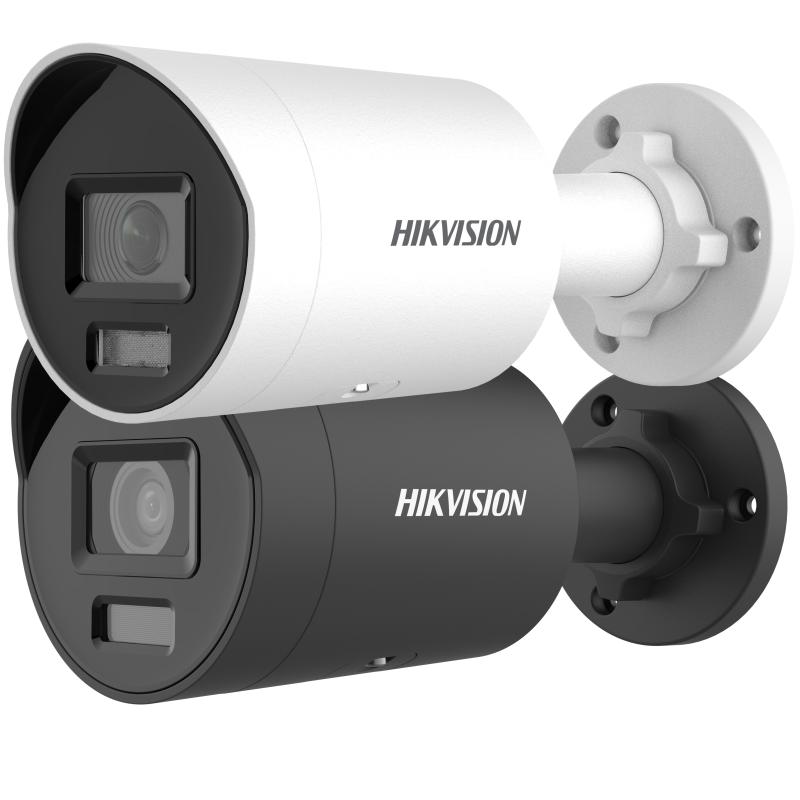
Night-time cameras have always forced an unpleasant choice. Infrared is invisible and polite, and gives you a monochrome picture in which a red car and a blue car look the same. White light gives you full colour, and blazes all night at your neighbours, your guests and your electricity bill while announcing precisely where the camera is.
This one refuses the choice. Left in its Smart mode it sits on infrared, dark and unobtrusive, until the camera classifies a human or a vehicle in the frame — at which point the white light comes on and the picture becomes colour. Nothing happens for a cat, a branch or a passing shadow, because the trigger is AcuSense classification rather than plain motion.
Underneath it is a proper ColorVu sensor: 1/1.8″, F1.0, 0.0005 lux, with 130 dB of wide dynamic range and supplement light reaching 40 m. All-metal body, 525 g, IP67, and it runs on 7 watts of standard 802.3af PoE. It comes in white and in black.
- White light on people and vehicles only, infrared the rest of the time
- Four selectable light modes: smart, infrared, white light, off
- ColorVu at 0.0005 lux, F1.0, on a large 1/1.8″ sensor
- 130 dB WDR, the widest in this series
- 4 MP, 2688 × 1520; 2.8 mm at 104° or 4 mm at 89.2°
- Supplement light to 40 m, infrared at 850 nm
- White or black finish; the black is listed in 2.8 mm
- All-metal, IP67, 525 g, PoE 802.3af max 7 W, built-in microphone
The light only comes on for people and vehicles
This is the feature the model is named after, so it is worth being exact about what it does. Hikvision’s own description of Smart Hybrid Light is short and unambiguous: white light on when humans or vehicles occur, infrared on when no human or vehicle appears.
The important word is classification. The switch is driven by the same deep-learning engine that separates people and vehicles from everything else, not by a motion threshold. Foliage moving in wind, rain, a fox crossing the drive — none of it turns the light on. A person walking up to the door does.
It is a mode, not a fixed behaviour, and you get four:
| Mode | While the scene is quiet | When a person or vehicle is classified |
| Smart | Infrared — covert, monochrome | White light — full colour |
| Infrared | Infrared throughout | Infrared, with the white light available as an alarm flash |
| White light | White light throughout, colour all night | White light |
| Off | No supplement light | White light available as an alarm flash |
Two honest notes. The supplement light reaches 40 m, so the effect stops there regardless of what the detection distances promise. And when the light does fire it is genuinely bright and genuinely visible — that is the deterrent working, but it is worth a thought before pointing one at a bedroom window across the street.
What this model does not have is a speaker. There is a built-in microphone on the -U, but no audio output and no alarm terminals, so there is no spoken warning or siren. That belongs to the /SL variants in the same family.
Behaviour confirmed against Hikvision UK’s Pro Series Smart Hybrid Light with ColorVu documentation. The product datasheet itself lists only the light types and range, not the switching logic.
What this camera actually covers
The lens is fixed and chosen at order. Switch between the two below: the 4 mm gives up fifteen degrees of width and returns fourteen metres of detection range.
Read the result against the 40 m supplement light, because on this camera the two numbers pull apart. At either focal length the detection figure runs past what the light reaches, so on an unlit site 40 m is the honest working edge after dark. Every angle and distance here is the manufacturer’s.
Loading the coverage diagram…
Full specification
Imaging, lens and DORI
| Image sensor | 1/1.8″ progressive scan CMOS |
| Max. resolution | 2688 × 1520 |
| Min. illumination | Colour 0.0005 lux (F1.0, AGC on); 0 lux with light |
| Shutter time | 1/3 s to 1/100,000 s |
| Day & night | IR cut filter |
| Angle adjustment | Pan 0° to 360°, tilt 0° to 90°, rotate 0° to 360° |
| Lens | Fixed focal, 2.8 mm or 4 mm, M16 mount, fixed iris, F1.0 |
| Focal length & FOV | 2.8 mm: horizontal 104.0°, vertical 54.4°, diagonal 126.7° 4 mm: horizontal 89.2°, vertical 45.5°, diagonal 108.2° |
| Depth of field | 2.8 mm: 2.5 m to ∞; 4 mm: 3.1 m to ∞ |
| DORI at 2.8 mm | D 61 m, O 24 m, R 12 m, I 6 m |
| DORI at 4 mm | D 75 m, O 30 m, R 15 m, I 7 m |
| Supplement light | Infrared and white light, up to 40 m, smart supplement light, 850 nm |
| WDR | 130 dB |
| SNR | ≥ 52 dB |
| Image enhancement | BLC, HLC, 3D DNR |
| Day / night switch | Day, night, auto, schedule |
| Privacy mask | 4 programmable polygon masks |
Video and streams
| Main stream | 50 Hz: 25 fps; 60 Hz: 30 fps (2688×1520, 1920×1080, 1280×720) |
| Sub-stream | 50 Hz: 25 fps; 60 Hz: 30 fps (1280×720, 640×480, 640×360) |
| Video compression | H.265+, H.265, H.264+, H.264; MJPEG on the sub-stream |
| Video bit rate | 32 Kbps to 8 Mbps |
| SVC | H.264 and H.265 encoding |
| Audio | -U models: built-in microphone. No speaker or audio output |
Network and interfaces
| Ethernet | 1 RJ45 10M/100M self-adaptive |
| API | ONVIF, ISAPI, SDK, ISUP |
| Network storage | NAS (NFS, SMB/CIFS), auto network replenishment (ANR) |
| On-board storage | microSD/microSDHC/microSDXC up to 512 GB |
| Built-in microphone | -U models: yes |
| Alarm interface | None |
| Reset key | Yes |
| Client | iVMS-4200, Hik-Connect, Hik-Central |
| Browser | Plug-in free live view on Chrome 57+, Firefox 52+, Edge 89+ |
Analytics and events
| Basic event | Motion detection with human and vehicle target classification, video tampering, exception |
| Smart event | Scene change detection |
| Face capture | Yes |
| Perimeter protection | Line crossing, intrusion, region entrance and exiting, triggered by human and vehicle targets |
| Linkage | Upload to FTP, NAS or memory card; notify surveillance centre; trigger recording and capture; email |
Power, housing and approvals
| Power | 12 VDC ±25%, 0.45 A, max. 5.5 W, Ø5.5 mm coaxial plug with reverse polarity protection; PoE IEEE 802.3af, Class 3, max. 7 W |
| Material | Front cover, body and bracket all metal |
| Dimensions | Ø74.4 mm × 179.2 mm |
| Weight | Approx. 525 g |
| Operating conditions | -30 °C to 60 °C, humidity 95% or less non-condensing |
| Protection | IP67 (IEC 60529-2013); no IK rating quoted |
| Anti-corrosion | None — the datasheet places this model in Hikvision’s “no specific protection” class, so not for coastlines, docks or chemical plants |
| EMC | CE-EMC, IC, KC, RCM |
| Safety | UL 62368-1, CB (IEC 62368-1), CE-LVD, BIS |
| Environment | CE-RoHS |
Available as DS-2CD2047G2H-LIU in 2.8 mm and 4 mm, in white or in black — the black finish is listed in 2.8 mm. DS-2CD2047G2H-LI is the same camera without the built-in microphone, and the DS-2CD2047G2H-LIU/SL adds a strobe and audio warning for active deterrence. Also written DS-2CD2047G2H-LIU and DS-2CD2047G2HLIU. For a DarkFighter bullet with longer infrared instead of hybrid light, see the DS-2CD2T46G2H-2I/4I. Specification sourced from the manufacturer datasheet, DS-2CD2047G2H-LI(U), 19 July 2023.
Works with SmartGard.AI
This camera already makes one judgement on its own, and it is a narrow one: is that shape a person or a vehicle. If yes, the light comes on. That is genuinely useful and it is also the whole of what the camera can decide. It has no idea whether the person is a delivery driver, a cleaner, the owner, or somebody who should not be there, and it has no idea whether three in the afternoon and three in the morning mean different things.
The system needs one thing from a camera: the ability to report that something happened. This one reports motion with human and vehicle classification, line crossing, intrusion, region entrance and exiting, face capture, scene change and tampering. SmartGard.AI reads the frame each trigger arrives with — and thanks to the hybrid light that frame is in colour rather than infrared grey, which is a materially better thing to reason over. It then judges it against zone rules written in your own words and decides whether anybody needs to hear about it.
The two work well together for a simple reason: the light and the alert fire on the same classification. When the white light comes on, a frame worth looking at is already on its way.
Already have cameras up? The same layer retrofits onto most modern IP installations without replacing what you already own.