
Hikvision iDS-7732NXI-M4/16P/X — 32-Channel DeepinMind 8K NVR
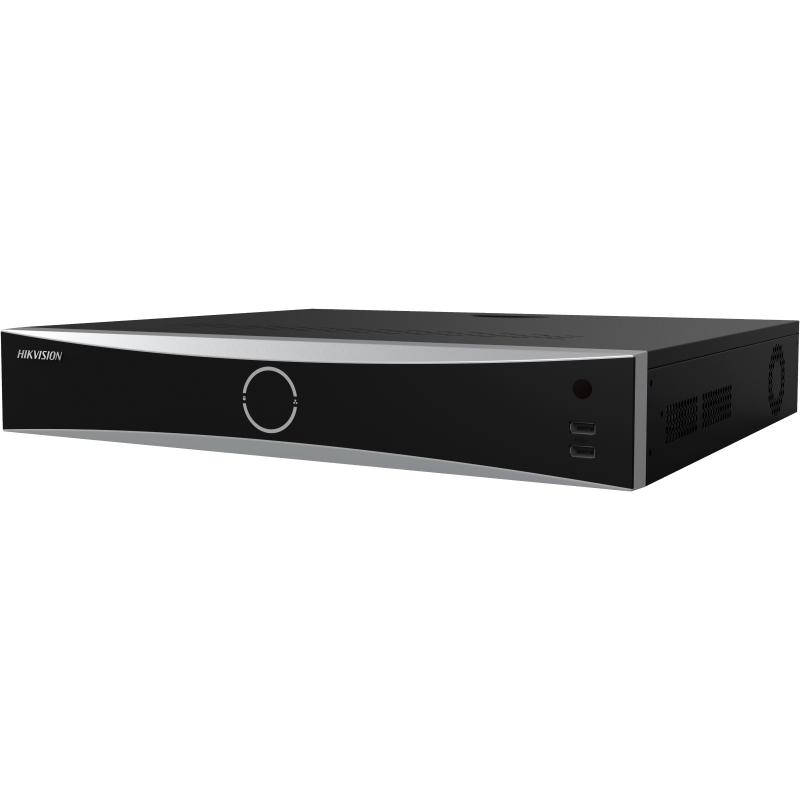
The DeepinMind recorders are where Hikvision stops treating analytics as a feature and starts treating it as a resource you allocate. This one carries two independent AI engines, each able to run its own algorithm, with the split between them adjustable.
That matters because on a thirty-two camera site the interesting question is never “can it do facial recognition”. It is “on how many channels, at what resolution, while also doing everything else”. The answer here is unusually generous and unusually specific: perimeter protection on 24 channels at 2 MP, or 16 at 4 MP, or 8 at 8 MP. Video structuralisation on up to twelve. Face comparison across 32 channels at 48 pictures per second, against libraries holding 100,000. Turn on the Large Model and those numbers halve, because it is a budget and you are spending it.
The rest is built to match: 8K on the first HDMI, a second independent 4K output, four drive bays plus eSATA, sixteen alarm inputs, RS-232 and two RS-485 ports.
- Two AI engines, each running its own algorithm, adjustable split
- 32 channels at up to 32 MP, 320 Mbps in, 400 Mbps out
- Perimeter protection by NVR on 24×2 MP, 16×4 MP or 8×8 MP
- Video structuralisation on up to 12 channels
- Face comparison on 32 channels at 48 pictures per second
- AcuSearch up to 691,200 targets per day
- 8K HDMI plus a second independent 4K output, 16-channel playback
- 4 SATA bays plus eSATA, 16 alarm inputs, RS-232 and 2× RS-485
What actually fits on this recorder
Four numbers decide what this box can really carry, and the first one surprises people every time.
Ports. Thirty-two channels, sixteen PoE sockets. The other sixteen cameras connect over your network and get power from somewhere else — a separate PoE switch, usually, which is a line item and a cabinet decision rather than an afterthought. Nothing is wrong with the recorder; the model name simply describes channels, not sockets.
PoE budget. Those sixteen ports share 200 W, about 12.5 W each. Comfortable for standard cameras, tight the moment you fit 802.3at models drawing 25 W. Six of those and the budget is gone.
Bandwidth. 320 Mbps incoming across 32 channels is 10 Mbps each. Thirty-two 4 MP cameras at 6 Mbps come to about 192 Mbps, comfortable. Thirty-two 8 MP cameras at high quality sit right on the ceiling.
Storage. Four bays at 16 TB gives 64 TB, which sounds enormous until you divide it. Thirty-two cameras averaging 6 Mbps write roughly 2 TB a day, so 64 TB is about a month of continuous recording. If your retention policy says ninety days, that is what the eSATA port and an expansion enclosure are for — and it belongs in the quote at the start.
Full specification
AI engines and analytics
| Engines | 2, each able to run an intelligent algorithm; engine mode adjustable |
| AI by NVR | Facial recognition, perimeter protection, video structuralisation, AcuSearch |
| AI by camera | Facial recognition, perimeter protection, video structuralisation, AcuSearch, motion detection 2.0, ANPR |
| Perimeter protection by NVR | 24×2 MP, 16×4 MP or 8×8 MP without Large Model; 12×2 MP, 8×4 MP or 4×8 MP with it |
| Video structuralisation | Up to 12×2 MP (6 per engine), 8×4 MP or 4×8 MP |
| Facial detection performance | Up to 16×2 MP (8 per engine), 8×4 MP or 4×8 MP |
| Face comparison, camera captures | 32 channels (24 per engine), 48 pictures per second |
| Face comparison, structured | 16 channels, 32 pictures per second |
| Face picture library | Up to 16 libraries, 100,000 pictures in list library, 10,000 per single list |
| AcuSearch by camera | All channels, up to 691,200 targets per day |
| AcuSearch by NVR | Up to 8 channels, up to 691,200 targets per day |
| ANPR | All channels by camera; plate number, colour and type; vehicle brand, colour and type |
Video, audio and decoding
| IP video input | 32 channels, up to 32 MP resolution |
| Incoming bandwidth | 320 Mbps |
| Outgoing bandwidth | 400 Mbps |
| Video output mode | HDMI1 and VGA1 simultaneous; HDMI1 and HDMI2 independent |
| HDMI 1 | 8K (7680×4320)/30 Hz, 4K/60 Hz, 4K/30 Hz, 2K/60 Hz, 1080p and below |
| HDMI 2 | 4K/60 Hz down to 1920×1080/60 Hz; limited to 1080p while HDMI1 runs 8K |
| VGA output | 1920×1080/60 Hz |
| CVBS output | 1 channel BNC, PAL 704×576 / NTSC 704×480 |
| Audio | 1 output RCA; 1 two-way audio channel RCA |
| Decoding format | H.265/H.265+/H.264/H.264+ |
| Decoding capability | 2×32 MP@30fps, 2×24 MP, 4×16 MP, 8×8 MP, 16×4 MP, 32 channels and more |
| Synchronous playback | 16 channels |
| Recording resolution | 32 MP down to QCIF |
Network, PoE and interfaces
| Network interface | 1 RJ-45 10/100/1000 Mbps self-adaptive |
| Protocols | TCP/IP, DHCP, IPv4, IPv6, DNS, DDNS, NTP, RTSP, SADP, SMTP, SNMP, NFS, iSCSI, ISUP, UPnP, HTTP, HTTPS |
| Camera access | ONVIF v2.5, RTSP |
| API | ONVIF (Profile S/G), SDK, ISAPI |
| Remote connections | 128 |
| Browsers | IE11, Chrome 57+, Firefox 52+, Safari 12+, Edge 89+ |
| PoE ports | 16 RJ-45 10/100 Mbps self-adaptive |
| PoE power | ≤ 200 W total, IEEE 802.3af/at |
| SATA | 4 interfaces, 3.5″ drives, up to 16 TB each |
| eSATA | 1 interface |
| Serial | 1× RS-232, 2× RS-485 half duplex |
| Alarm in / out | 16 / 4 |
| USB | Front: 2× USB 2.0; rear: 1× USB 3.0 |
Power, housing and approvals
| Power supply | 100 to 240 VAC, 50 to 60 Hz |
| Consumption | ≤ 50 W without drives, PoE off |
| Dimensions | 445 × 400 × 71 mm (1.5U) |
| Weight | ≤ 5 kg without drives |
| Working conditions | -10 °C to 55 °C, humidity 10% to 90% |
| Certification | CE, FCC, IC, CB, KC, UL, RoHS, REACH, WEEE, RCM, UKCA, LOA, BIS |
| Interface languages | English, Polish, German, French, Italian, Czech, Dutch and more |
Also listed as iDS-7732NXI-M4/16P/X and iDS-7732NXI-M4-16P-X. The DeepinMind line also includes iDS-7716NXI-M4/X and iDS-7732NXI-M4/X without PoE, and the larger iDS-9616NXI-M8/X and iDS-9664NXI-M16/X chassis. For an eight-channel recorder on a smaller site, see the DS-7608NXI-K2/8P(E). Specification sourced from the manufacturer product page.
Works with SmartGard.AI
A recorder with two AI engines is very good at answering “what is it”. Person, vehicle, face, plate, structured attributes, all of it catalogued and searchable. What no recorder answers is “does it matter here, now” — and on a thirty-two camera site that is the only question that determines whether anyone still looks at the alerts by the end of the month.
SmartGard.AI does not read from your recorder, replace it, or interfere with it. This NVR keeps recording on your retention policy and the footage stays yours, where it is. The system works from what the cameras report, reads the frame each event arrives with, and judges it against zones described in your own words. Thirty-two cameras produce a great many events; the value of the layer scales with exactly that number.
Already have this recorder installed? That is the usual case on a site this size. The layer retrofits onto most modern IP installations without replacing what you already own, and the privacy position is written down rather than buried in a contract — which matters more when face libraries are involved.