
Hikvision DS-7608NXI-K1/8P/VPro — 8-Channel AcuSeek NVR
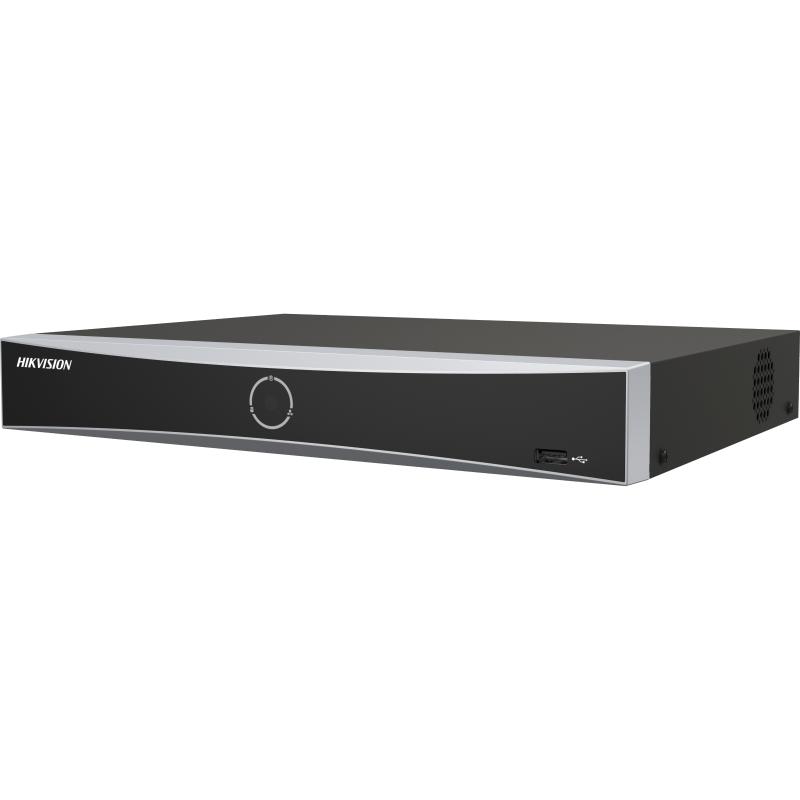
Everybody who has ever had to find something on CCTV knows the actual job. You have a rough time, a rough place and a rough description, and ahead of you sit four hours of footage and a scrub bar. It is the least pleasant part of owning a camera system and it is where most investigations quietly die.
AcuSeek is Hikvision’s answer, and it is a good one: you type what you are looking for in ordinary English and the recorder returns the clips that match. Not a motion timeline, not a grid of thumbnails — a description, turned into results.
One condition, and it is important enough to state before the specification rather than after: AcuSeek depends on your cameras, not on this box. The recorder can only search what the cameras have described to it, so the feature works on channels where the camera supports both AcuSense and AcuSearch. Hang eight legacy cameras off it and the headline feature has nothing to work with. Check that before you buy, not after.
- AcuSeek — plain-English search across recorded events
- AcuSearch on all channels where the camera supports it
- 8 channels, 8 PoE ports, 75 W budget
- AcuSense on the recorder for human and vehicle filtering
- Face comparison, 16 lists, up to 50,000 pictures
- 80 Mbps in and out, 8-channel synchronous playback
- 1 SATA bay, up to 16 TB, 4K HDMI plus independent VGA
- Compact 1U, 319 mm wide, under 1 kg, ≤ 10 W without a drive
What actually fits on this recorder
“Eight channels” is the number on the box. Three others decide what you can really do with it.
Bandwidth. 80 Mbps incoming, so 10 Mbps per channel across eight. Eight 4 MP cameras in H.265 at 25 fps typically want 4 to 6 Mbps each and fit comfortably. Eight 8 MP cameras at good quality want 8 to 12 Mbps each and do not. Outgoing is also 80 Mbps here rather than the 160 on the larger Pro Series box, which matters if several people watch remotely at once.
PoE budget. Eight ports share 75 W, about 9 W each. Fine for standard 802.3af cameras. The 802.3at models in this catalogue — the panoramic ColorVu pair, the PTRZ domes — will use the whole budget in threes, and the rest will need a separate switch or injectors.
Storage. One bay, so up to 16 TB total, and that single bay is the real difference between this and the two-bay Pro Series. As a worked example: eight cameras averaging 6 Mbps write roughly 520 GB a day, which fills 16 TB in about a month. If you need three months of continuous footage, plan for a bigger chassis or record on events.
The trade this box makes is deliberate: less storage and less remote headroom, in exchange for being able to find things.
Full specification
Intelligent analytics and search
| AI by NVR | Facial recognition, perimeter protection, motion detection 2.0, AcuSearch, AcuSeek |
| AI by NVR and camera | Facial recognition, perimeter protection, motion detection 2.0, ANPR, VCA |
| AcuSeek | English-language event search, where cameras support AcuSense and AcuSearch |
| AcuSearch | All channels, where the camera supports the AcuSearch function |
| Perimeter protection by NVR | Up to 4 MP: 2 channels; 5 to 8 MP: 1 channel |
| Facial detection by NVR | Up to 4 MP: 2 channels; 5 to 8 MP: 1 channel |
| Face picture library | Up to 16 lists, up to 50,000 pictures |
Video, audio and decoding
| IP video input | 8 channels |
| IP speaker input | 4 channels |
| Incoming bandwidth | 80 Mbps |
| Outgoing bandwidth | 80 Mbps |
| Video output | Independent HDMI and VGA |
| HDMI output | Up to 4K (3840×2160)/30 Hz |
| VGA output | Up to 1080p/60 Hz |
| Audio | 1 input, two-way, RCA; 1 output, RCA |
| Decoding format | H.265, H.265+, H.264, H.264+ |
| Recording resolution | 12/8/6/5/4/3 MP, 1080p, UXGA, 720p, VGA, 4CIF, DCIF, 2CIF, CIF, QCIF |
| Decoding, AI on | 2×12 MP@30fps, 3×8 MP@30fps, 4×6 MP@30fps, 6×4 MP@30fps |
| Decoding, AI off | 4×12 MP@30fps, 6×8 MP@30fps, 8×6 MP@30fps, 8×4 MP@30fps |
| Synchronous playback | 8 channels |
| Screen split | 1/2/4/6/8/9 |
| Playback modes | Normal, smart, event, tag, external file |
| Audio compression | G.711ulaw, G.711alaw, G.722, G.726, AAC, MP2L2 |
Network, PoE and interfaces
| Network interface | 1 RJ-45 10/100/1000 Mbps self-adaptive |
| Protocols | TCP/IP, DHCP, IPv4, IPv6, DNS, DDNS, NTP, RTSP, SADP, SMTP, SNMP, NFS, iSCSI, ISUP, UPnP, HTTP, HTTPS |
| Remote connections | 128 |
| PoE ports | 8 RJ-45 10/100 Mbps self-adaptive |
| PoE power | ≤ 75 W total, IEEE 802.3af/at |
| SATA | 1 interface, up to 16 TB |
| Alarm in / out | 4 / 1 |
| USB | Front: 1× USB 2.0; rear: 1× USB 2.0 |
Power, housing and approvals
| Power supply | 48 VDC, 1.875 A |
| Consumption | ≤ 10 W without a drive |
| Dimensions | 319 × 240 × 48 mm |
| Weight | ≤ 1 kg without a drive |
| Working conditions | -10 °C to +55 °C, humidity 10% to 90% |
| Certification | CE, CB, REACH, WEEE, UKCA, RCM, IC |
Also listed as DS-7608NXI-K1/8P/VPro and DS-7608NXI-K1-8P-VPro. The VPro AcuSeek line runs to 26 models in 4, 8, 16 and 32-channel versions with and without PoE, including DS-7604NXI-K1/VPro and DS-7604NXI-K1/4P/VPro. For two drive bays and more outgoing bandwidth, see the DS-7608NXI-K2/8P(E). Specification sourced from the manufacturer product page.
Works with SmartGard.AI
This is the one recorder in the catalogue where somebody will reasonably ask whether they need us at all, so here is the straight answer: AcuSeek and SmartGard.AI point in opposite directions in time, and that is the whole distinction.
AcuSeek searches the past. Something has already happened, you know roughly what, and you need to find it in yesterday’s footage. It is excellent at that and it saves hours.
SmartGard.AI watches the present. Nothing has happened yet as far as anyone knows, and the question is whether the event that just arrived deserves to wake somebody at three in the morning. That judgement has to be made in the moment, against the zones and rules of your site, and no amount of search quality helps with it.
Most sites want both, for the same reason you want a good filing system and a doorbell. The recorder keeps recording exactly as it does now — SmartGard.AI does not read from it, replace it, or interfere with it — and the system works from what your cameras report. Worth noting that the cameras which unlock AcuSeek are the same AcuSense models that make the best triggers, so the two features tend to arrive together.
Already have cameras up? The layer retrofits onto most modern IP installations without replacing what you already own.