
Hikvision DS-2CD3746G2T-IZS(Y) — 4 MP AcuSense Varifocal Turret
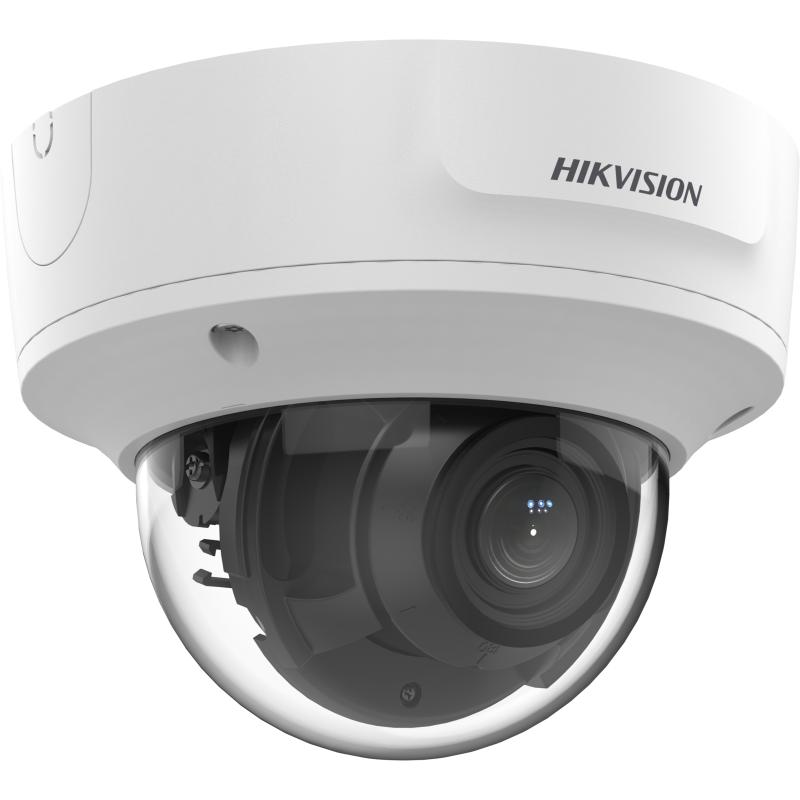
This turret is really two cameras wearing the same housing, and the fork happens at the order form. Specify the 2.7–13.5 mm lens and you get a general-purpose camera that opens to 107.6 degrees. Specify the 7–35 mm and you get an instrument that closes to 10.5 degrees and identifies a face at 58 metres.
That second figure deserves a moment. Fifty-eight metres of identification is close to ten times what a wide-angle dome manages, and detection runs out at 580 m. It is the difference between a camera that watches a yard and one that watches an approach road — and getting the choice wrong is expensive, because it is not a setting you can change afterwards.
Both variants carry the same brains: AcuSense classification, the HEOP open platform with 1.5 TOPS for your own models in C or C++, and unusually generous I/O at two alarm inputs and two outputs.
- 4 MP, 2688 × 1520, motorised zoom with auto focus and auto iris
- Two lens options: 2.7–13.5 mm at F1.4, or 7–35 mm at F1.6
- 107.6° to 10.5° horizontal across the two options
- Identify from 6 m to 58 m; detect from 64 m to 580 m
- HEOP 2.0, 1.5 TOPS, C and C++, five ML frameworks
- IR to 40 m or 50 m depending on lens
- 2 alarm inputs, 2 outputs, unattended baggage and people counting
- IP67, IK10, PoE 802.3at, 120 dB WDR
What this camera actually covers
Four positions below, because there are two lens options and each has a wide and a long end. The first two are the standard 2.7–13.5 mm lens; the last two are the optional 7–35 mm. Step through them in order and watch a broad fan narrow into something closer to a searchlight beam. This is the single best illustration in the catalogue of what focal length costs and what it buys.
Loading the coverage diagram…
Full specification
Imaging, lens and DORI
| Image sensor | 1/3″ progressive scan CMOS |
| Max. resolution | 2688 × 1520 |
| Min. illumination | Colour 0.003 lux (F1.4, AGC on); B/W 0 lux with IR |
| Shutter time | 1/3 s to 1/100,000 s |
| Angle adjustment | Pan 0–355°, tilt 0–75°, rotate 0–355° |
| Lens type | Varifocal, motorised; 2.7–13.5 mm or 7–35 mm |
| Focal length & FOV | 2.7–13.5 mm: horizontal 107.6° to 32.9°; 7–35 mm: horizontal 28.7° to 10.5° |
| Focus | Auto, semi-auto, manual |
| Iris | Auto-iris |
| Aperture | 2.7–13.5 mm: F1.4; 7–35 mm: F1.6 |
| DORI (2.7–13.5 mm) | D 64–187 m, O 25–74 m, R 12–37 m, I 6–18 m |
| DORI (7–35 mm) | D 218–580 m, O 86–230 m, R 43–116 m, I 21–58 m |
| WDR | 120 dB |
| SNR | ≥ 52 dB |
| Image enhancement | BLC, HLC, 3D DNR, defog |
| Privacy mask | 4 programmable polygon masks |
| Supplement light | Up to 40 m (2.7–13.5 mm) or 50 m (7–35 mm), smart supplement light, 850 nm |
HEOP edge AI platform
| Open capability | HEOP 2.0 OpendevSDK |
| Computing power | 1.5 TOPS |
| Open resources | Memory 60 MB; smart RAM 400 MB; eMMC 2 GB |
| Deep learning frameworks | Caffe, PyTorch, TensorFlow, PaddlePaddle, ONNX |
| Programming languages | C, C++ |
Video, audio and network
| Main stream | 50 Hz: 25 fps; 60 Hz: 30 fps (2688×1520, 1920×1080, 1280×720) |
| Video compression | Main: H.265/H.264/H.264+/H.265+; sub: H.265/H.264/MJPEG |
| Video bit rate | 32 Kbps to 8 Mbps |
| SVC | H.264 and H.265 encoding |
| ROI | 5 fixed regions for main and sub-stream |
| Audio | G.711/G.722.1/G.726/MP2L2/PCM/MP3/AAC-LC; noise filtering |
| Protocols | TCP/IP, ICMP, HTTP, HTTPS, FTP, DHCP, DNS, DDNS, RTP, RTSP, NTP, UPnP, SMTP, IGMP, 802.1X, QoS |
| API | ONVIF (Profile S/G/T), ISAPI, SDK, ISUP |
| Simultaneous live view | Up to 6 channels |
| Client | iVMS-4200, Hik-Connect, Hik-Central |
| Ethernet | 1 RJ45 10M/100M |
| Storage | microSD/microSDHC/microSDXC up to 512 GB; NAS (NFS, SMB/CIFS), ANR |
| Alarm | 2 inputs, 2 outputs (max. 24 VDC/24 VAC, 1 A) |
| Audio interfaces | 1 line in, 1 line out |
Analytics and events
| Basic event | Motion detection with human and vehicle triggering, video tampering |
| Smart event | Scene change, audio exception, defocus, unattended baggage detection |
| Face capture | Yes |
| People counting | Yes |
| Perimeter protection | Line crossing, intrusion, region entrance and exiting, with human and vehicle triggering |
Power, housing and approvals
| Power | 12 VDC ±25%, 1.25 A, max. 15 W; PoE IEEE 802.3at, Class 4, max. 18 W |
| Material | Metal |
| Dimensions | Ø153.3 mm × 111.6 mm |
| Weight | Approx. 910 g |
| Operating conditions | -30 °C to 60 °C, humidity ≤ 95% |
| Protection | IP67, IK10 |
| Anti-corrosion | -Y models: NEMA 4X |
Also listed as DS-2CD3746G2T-IZSY and DS-2CD3746G2T-IZS(Y). Siblings on the same Ultra Series platform include the DS-2CD3T46G2-4IS(Y) bullet, the DS-2CD3646G2-IZS varifocal dome, and 8 MP versions DS-2CD3786G2T-IZS(Y) and DS-2CD3T86G2-4IS(Y). For a ColorVu fixed-lens option on the same platform, see the DS-2CD3347G3-LISU. Specification sourced from the manufacturer product page.
Works with SmartGard.AI
Long lenses have a specific failure mode: they see things a long way off, and a long way off is where you have the least idea what you are looking at. A figure at 200 metres crossing a line is an event. Whether it is a trespasser, a dog walker on the footpath behind your fence, or a fox, is a question the camera is not equipped to answer.
The system needs one thing from a camera: the ability to report that something happened. This one reports motion with human and vehicle triggering, line crossing, intrusion, region entrance and exiting, people counting, face capture, unattended baggage, scene change, defocus and audio exception. SmartGard.AI takes those triggers, looks at the frame, and judges it against zone rules written in your own words — which is exactly the context a camera pointed down a long approach cannot supply for itself.
Already have cameras up? The same layer retrofits onto most modern IP installations without replacing what you already own.