
Hikvision DS-2CD3347G3-LISU(Y) — 4 MP ColorVu Dome with Edge AI
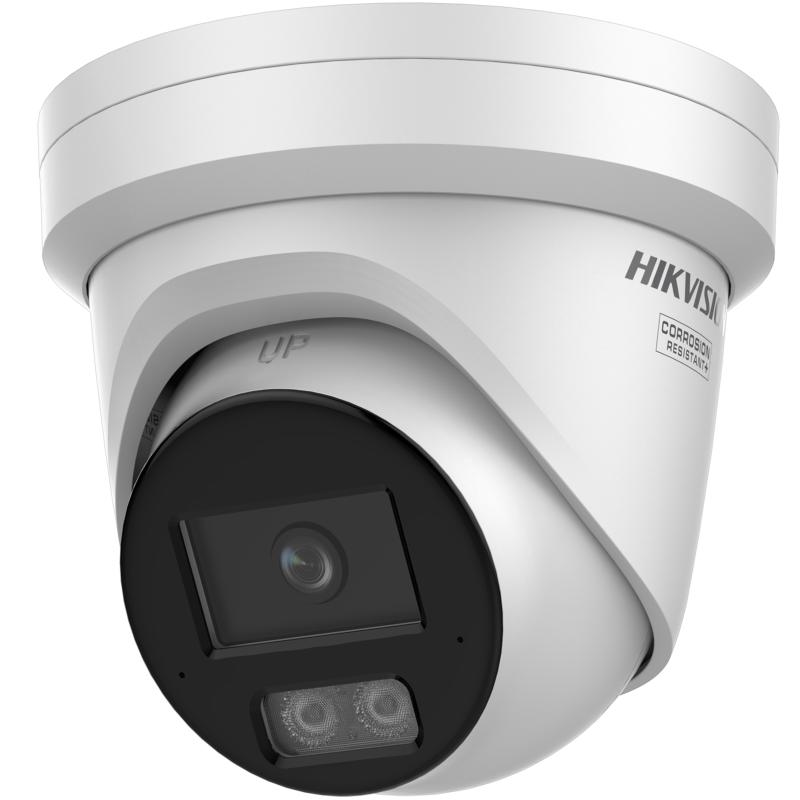
Two numbers make this dome unusual, and neither is the megapixel count.
The first is 0.0001 lux. That is the lowest figure anywhere in this catalogue, an order of magnitude below cameras that already advertise themselves as good in the dark, and it comes from an F1.0 lens in front of a large 1/1.8″ sensor. Practically it means colour where other cameras have long since given up and gone grey.
The second is 1.5 TOPS. This camera carries Hikvision’s HEOP open platform, which is a polite way of saying there is a compute budget on board that is not spoken for — 60 MB of memory, 450 MB of smart RAM, 2 GB of eMMC, and support for models built in Caffe, PyTorch, TensorFlow, PaddlePaddle or ONNX. Most cameras are appliances. This one is closer to a small computer that happens to have a very good lens bolted to the front, and if you have a detection problem nobody sells a product for, that distinction is the whole reason to buy it.
- 0.0001 lux in colour at F1.0 — the darkest-capable camera here
- HEOP 2.0 open platform, 1.5 TOPS, Caffe / PyTorch / TensorFlow / PaddlePaddle / ONNX
- 4 MP, 2688 × 1520 on a 1/1.8″ sensor
- Fixed 2.8 mm or 4 mm, 111.1° or 95.2° horizontal
- IR and white light to 40 m, with smart supplement light
- 130 dB WDR, electronic image stabilisation, defog
- People counting, face capture, defocus and audio exception detection
- PoE 802.3af, max 11 W — gentle on a loaded switch
What this camera actually covers
This model ships with either a 2.8 mm or a 4 mm fixed lens, and you choose once, at order time. Switch between them below to see what that choice actually buys you: the 4 mm gives up sixteen degrees of width and returns fourteen metres of detection range. Set your own mounting height and tilt while you are there.
Loading the coverage diagram…
Full specification
Imaging, lens and DORI
| Image sensor | 1/1.8″ progressive scan CMOS |
| Max. resolution | 2688 × 1520 |
| Min. illumination | Colour 0.0001 lux (F1.0, AGC on); 0 lux with light |
| Shutter time | 1 s to 1/100,000 s |
| Angle adjustment | Pan 0–360°, tilt 0–75°, rotate 0–360° |
| Lens type | Fixed focal, 2.8 mm or 4 mm, M16 mount |
| Focal length & FOV | 2.8 mm: horizontal 111.1°; 4 mm: horizontal 95.2° |
| Aperture | F1.0 |
| Depth of field | 2.8 mm: 2.5 m to ∞; 4 mm: 3.1 m to ∞ |
| DORI at 2.8 mm | D 61 m, O 24 m, R 12 m, I 6 m |
| DORI at 4 mm | D 75 m, O 30 m, R 15 m, I 7 m |
| WDR | 130 dB |
| SNR | ≥ 52 dB |
| Image enhancement | BLC, HLC, 3D DNR, distortion correction, defog |
| Image stabilisation | EIS |
| Privacy mask | 8 programmable polygon masks |
| Supplement light | IR and white light, up to 40 m, smart supplement light, 850 nm |
HEOP edge AI platform
| Open capability | HEOP 2.0 OpendevSDK |
| Computing power | 1.5 TOPS |
| Open resources | Memory 60 MB; smart RAM 450 MB; eMMC 2 GB |
| Deep learning frameworks | Caffe, PyTorch, TensorFlow, PaddlePaddle, ONNX |
Video, audio and network
| Main stream | 50 Hz: 25 fps (2688×1520), 50 fps (1920×1080 / 1280×720); 60 Hz equivalents at 30/60 fps |
| Video compression | Main: H.265/H.264/H.264+/H.265+; sub, third and fourth: H.265/H.264/MJPEG |
| Video bit rate | 32 Kbps to 8 Mbps |
| ROI | 5 fixed regions for main and sub-stream |
| e-PTZ | Patrol and auto-tracking settings |
| AI encoding | Supported |
| Audio | Mono; G.711/G.722.1/G.726/MP2L2/PCM/MP3/AAC-LC; noise filtering |
| Protocols | TCP/IP, ICMP, HTTP, HTTPS, FTP, DHCP, DNS, DDNS, RTP, RTSP, RTCP, NTP, UPnP, SMTP, IGMP, 802.1X, QoS |
| API | ISAPI, SDK, ISUP, ONVIF (Profile S/T/G/M) |
| Simultaneous live view | Up to 6 channels |
| Client | iVMS-4200, Hik-Connect, Hik-Central |
| Ethernet | 1 RJ45 10M/100M |
| Storage | microSD/microSDHC/microSDXC up to 512 GB; NAS (NFS, SMB/CIFS), ANR |
| Audio interfaces | Arrayed dual microphone, 1 line in, 1 line out |
Analytics and events
| Basic event | Motion detection with human and vehicle triggering, video tampering |
| Smart event | Scene change, audio exception, defocus detection |
| Face capture | Yes |
| People counting | Yes |
| Perimeter protection | Line crossing, intrusion, region entrance and exiting, with human and vehicle triggering |
Power, housing and approvals
| Power | 12 VDC ±25%, 0.7 A, max. 8.5 W; PoE IEEE 802.3af, Class 3, max. 11 W |
| Material | Metal cover and body |
| Dimensions | Ø138.3 mm × 115.4 mm |
| Weight | Approx. 800 g |
| Operating conditions | -30 °C to 60 °C, humidity ≤ 95% |
| Protection | IP67 |
| Anti-corrosion | -Y models: NEMA 4X |
Also listed as DS-2CD3347G3-LISUY and DS-2CD3347G3-LISU(Y), with the -Y suffix denoting NEMA 4X anti-corrosion. The turret sibling on the same platform is the DS-2CD3147G3-LISU(Y). For a motorised lens on the same Ultra Series platform, see the DS-2CD3746G2T-IZS. Specification sourced from the manufacturer product page.
Works with SmartGard.AI
A camera with its own AI and a system with its own AI sounds like a duplication. It is not, because they answer different questions. The camera decides what is in the frame — person, vehicle, count, direction. SmartGard.AI decides whether it matters, which needs the thing the camera does not have: the context of your site, in your words, at this hour, in this zone.
The system needs one thing from a camera: the ability to report that something happened. This one reports motion with human and vehicle triggering, line crossing, intrusion, region entrance and exiting, people counting, face capture, scene change, defocus and audio exception. If you have written your own detector on the HEOP platform, its output is an event too, and events are exactly what the system consumes.
Already have cameras up? The same layer retrofits onto most modern IP installations without replacing what you already own.