
Hikvision DS-2CD2T87G3P-LIS2UY — 8 MP Panoramic ColorVu Bullet
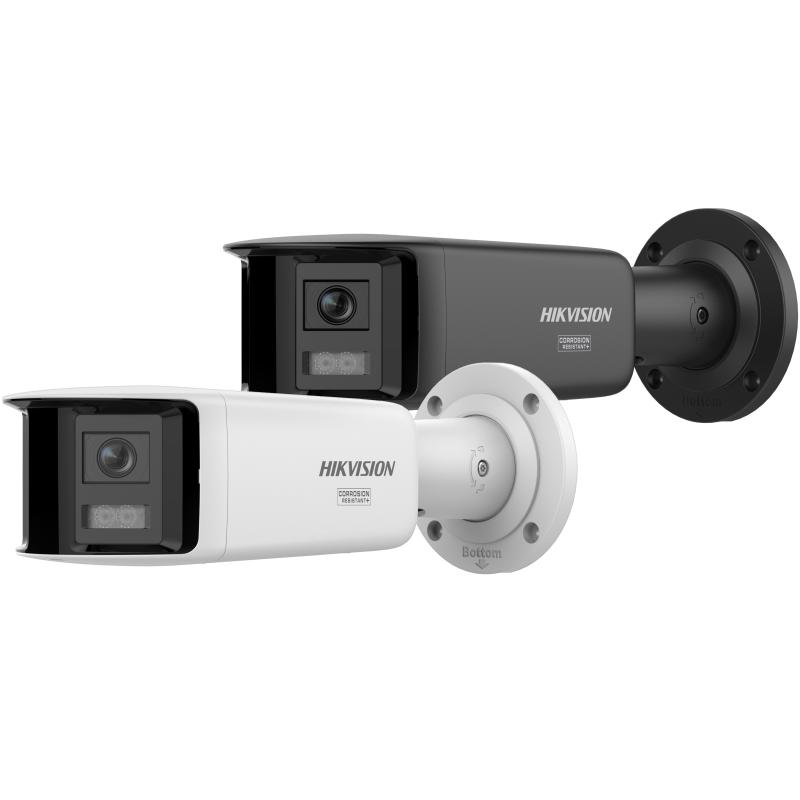
Optically this is the panoramic turret. Same 1/2.5″ sensor, same 4256 × 1888 frame, same 182.6 degree fixed lens, same ColorVu behaviour after dark. If you compared two recordings side by side you would not be able to tell which was which.
The difference is the housing, and the housing is the point. A turret is discreet; a bullet is a statement. Thirty centimetres of metal on a bracket, pointed unmistakably at the gate, tells anyone approaching that they have been seen before they have done anything worth seeing. Deterrence that never files an alert is still deterrence. The bullet form also buys reach: the supplement light throws 40 m rather than 30, because there is room in the body for a bigger illuminator.
- 8 MP panoramic, 4256 × 1888 on a 1/2.5″ sensor
- 182.6° horizontal, 74.6° vertical from one fixed 2.8 mm lens
- ColorVu — full colour at 0.0005 lux, F1.0 aperture
- White light and IR to 40 m, ten metres further than the turret
- Built-in speaker at 110 dB, plus white or red-and-blue strobe on /SL and /SRB
- 130 dB WDR, distortion correction and defog
- AcuSense human and vehicle classification on every event
- IP67, NEMA 4X, PoE 802.3at, 1440 g of metal
What this camera actually covers
Bullets tend to go high, on a wall or a pole, and height is exactly what changes the answer. Push the mounting height slider below and watch the blind zone at the base grow: the higher you put a 182.6 degree lens, the more ground directly beneath it you stop seeing. Worth knowing before the bracket goes up rather than after.
Loading the coverage diagram…
Full specification
Imaging, lens and DORI
| Image sensor | 1/2.5″ progressive scan CMOS |
| Max. resolution | 4256 × 1888 |
| Min. illumination | Colour 0.0005 lux (F1.0, AGC on); 0 lux with light |
| Shutter time | 1 s to 1/100,000 s |
| Angle adjustment | Pan 0–360°, tilt 0–90°, rotate 0–360° |
| Lens type | Fixed focal, 2.8 mm, M12 mount |
| Focal length & FOV | 2.8 mm, horizontal 182.6°, vertical 74.6° |
| Aperture | F1.0 |
| Depth of field | 1.6 m to ∞ |
| DORI | D 62 m, O 24 m, R 12 m, I 6 m |
| WDR | 130 dB |
| SNR | ≥ 52 dB |
| Image enhancement | BLC, HLC, 3D DNR, distortion correction, defog |
| Privacy mask | 4 programmable polygon masks |
| Supplement light | White light and IR, up to 40 m, smart supplement light, 850 nm |
Video and audio
| Main stream | 20 fps (4256×1888, 4096×1856) at 50/60 Hz |
| Sub-stream | 20 fps (1200×536, 960×432) |
| Video bit rate | 32 Kbps to 24 Mbps |
| Video compression | Main: H.265/H.264/H.264+/H.265+; sub: H.265/H.264/MJPEG |
| SVC | H.264 and H.265 encoding |
| ROI | 1 fixed region per stream |
| Audio type | -U models: mono sound |
| Audio compression | G.711/G.722.1/G.726/MP2L2/PCM/MP3/AAC-LC |
Network and interfaces
| Protocols | IPv4, IPv6, HTTP, RTSP, SSL/TLS, SFTP, FTP, DNS, DDNS, DHCP, PPPoE, SMTP, SNMP, NTP, IGMP, QoS, WebSockets |
| Simultaneous live view | Up to 6 channels |
| API | ONVIF (Profile S/G/T), ISAPI, SDK, ISUP |
| Client | iVMS-4200, Hik-Connect, Hik-Central |
| Ethernet | 1 RJ45 10M/100M |
| On-board storage | microSD/microSDHC/microSDXC up to 512 GB |
| Speaker | Max. 2 W, 110 dB at 10 cm |
| Audio interfaces | Built-in mic (-2U arrayed dual), 1 line in, 1 line out |
| Alarm | 1 input, 1 output (max. 24 VDC/24 VAC, 1 A) |
Analytics and events
| Basic event | Motion detection with human and vehicle classification, video tampering |
| Smart event | Scene change detection |
| Perimeter protection | Line crossing, intrusion, region entrance and exiting, with human and vehicle triggering |
Power, housing and approvals
| Power | 12 VDC ±25%, 1.67 A, max. 20 W; PoE IEEE 802.3at, Class 4, max. 24 W |
| Material | Front cover, body and bracket: metal |
| Dimensions | 118.6 × 78 × 306.5 mm |
| Weight | Approx. 1440 g |
| Operating conditions | -30 °C to 60 °C, humidity ≤ 95% |
| Flashing light | /SL white; /SRB red and blue |
| Protection | IP67 |
| Anti-corrosion | NEMA 4X |
| Compliance | CE-RoHS, WEEE, REACH |
Sold under several variant names: DS-2CD2T87G3P-LIS2UY/SL with the white warning light, DS-2CD2T87G3P-LIS2UY/SRB with the red-and-blue strobe, and a black finish option. The same optics in a turret housing are the DS-2CD2387G3P-LIS2UY. Specification sourced from the manufacturer product page.
Works with SmartGard.AI
A camera this visible gets tested. People walk up to it, stand in front of it, and wave at it, and every one of those is an event landing on somebody’s phone. SmartGard.AI sits between the camera and that phone and decides which ones deserve to arrive.
The system needs one thing from a camera: the ability to report that something happened. This one reports motion with human and vehicle classification, line crossing, intrusion, region entrance and exiting, scene change and tampering. Each becomes a trigger. SmartGard.AI then reads the frame against zone rules written in your own words — a delivery driver at the gate at ten in the morning is not the same event as the same person at the same gate at two in the morning, and the difference is the whole product.
Already have cameras up? The same layer retrofits onto most modern IP installations without replacing what you already own.