
Hikvision DS-2DP8A440IXG1-LEF/416(F0) — 16 MP Panoramic and PTZ Camera
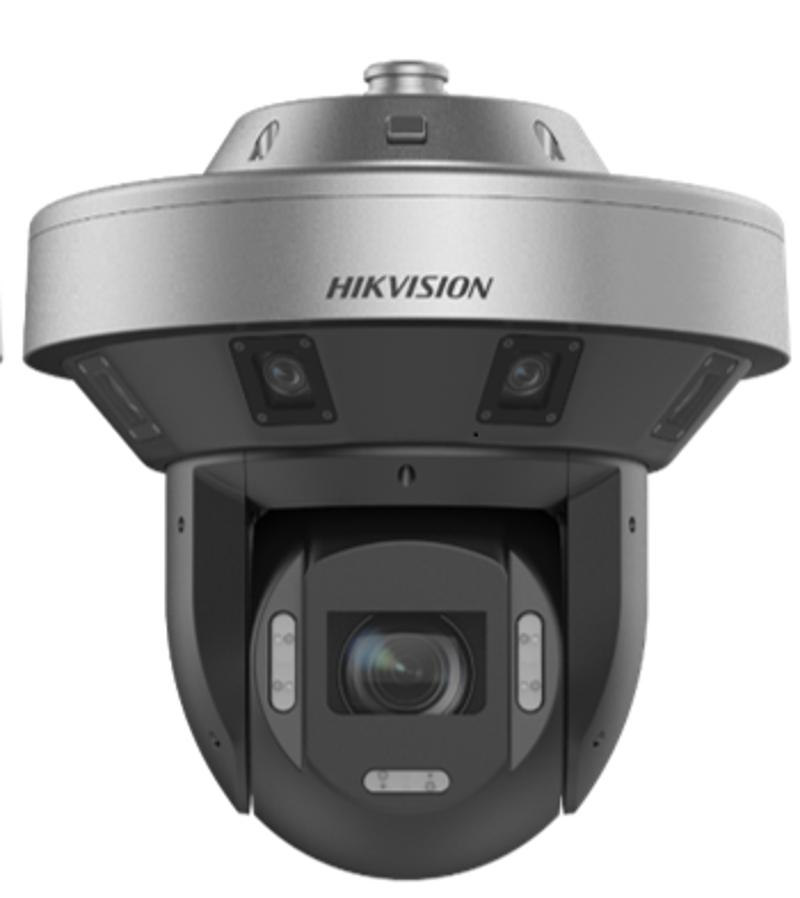
Every PTZ makes the same uncomfortable trade. While it is zoomed in on one thing it is, by definition, not watching anything else, and the moment an operator or an auto-track decides to follow a figure across the yard, the rest of the yard goes unrecorded. Reviewing that footage afterwards is an exercise in guessing what you missed.
This camera stops making the trade. A 16 megapixel panoramic channel covers 180 degrees horizontally and 110 vertically, fixed, continuous, recording all of it at 5520 × 2400 whatever else is happening. Alongside it, a separate 40x PTZ head runs from 6 to 240 mm and closes to 1.8 degrees. The panorama never blinks; the PTZ goes and looks.
The tracking is built around that arrangement rather than bolted onto it: panorama tracking uses the wide channel to spot movement and hands the target to the zoom head, and patrol tracking passes attention between multiple detection zones. Infrared reaches 300 m. There is a fibre port on the back, 135 watts going in, and 14.6 kg of camera on the bracket. Nobody clips this to a soffit.
- 16 MP panorama at 5520 × 2400, fixed 180° horizontal by 110° vertical
- 40x optical PTZ, 6–240 mm, 56.6° down to 1.8°
- Both channels record simultaneously, independently
- Panorama tracking hands targets from the wide channel to the zoom head
- 0.0005 lux colour on both channels, F1.0 panoramic, F1.2 PTZ
- Infrared to 300 m, PTZ pan to 500°/s, tilt to 350°/s
- People density and congestion alarms on the panoramic channel
- Fibre FC port and gigabit copper, 7 alarm inputs, IP67, -40 °C to 70 °C
Why there is no coverage diagram on this page
Fixed cameras in this catalogue carry an interactive diagram of exactly what they cover. This one is half fixed and half moving, and Hikvision publishes no DORI distances for either channel — so rather than invent figures that would not be comparable with the manufacturer numbers used elsewhere here, we have left the diagram out.
What can be said without inventing anything: the panoramic channel is genuinely fixed at 180 degrees by 110, so its coverage is a known quantity once the mounting height and tilt are set. The PTZ head has no fixed coverage at all, by design. And the infrared reaches 300 metres, which on an unlit site is the real limit on both regardless of what the optics could resolve in daylight.
If you need certainty about a specific area rather than reach across a large one, a fixed camera is the better instrument, and its page will show you precisely what it sees.
Full specification
Imaging and lenses
| Image sensors | Panoramic and PTZ channels: 1/1.8″ progressive scan CMOS |
| Max. resolution | 5520 × 2400 (panoramic) |
| Min. illumination | Panoramic: colour 0.0005 lux, B/W 0.0001 lux (F1.0); PTZ: colour 0.0005 lux, B/W 0.0001 lux (F1.2); 0 lux with IR |
| Shutter speed | 1 s to 1/30,000 s, slow shutter supported |
| Focal length | Panoramic: 2 mm fixed; PTZ: 6 to 240 mm |
| Field of view | Panoramic: horizontal 180°, vertical 110°; PTZ: horizontal 56.6° to 1.8° |
| Zoom | PTZ channel: 40x optical, 16x digital; approx. 5.6 s wide to tele |
| Aperture | Panoramic max. F1.0; PTZ max. F1.2 |
| Focus | Auto, semi-auto, manual, rapid focus |
| Supplement light | Infrared up to 300 m, smart supplement light |
| WDR | PTZ channel: 120 dB; panoramic channel: none |
| SNR | ≥ 55 dB |
| Defog | PTZ channel: optical defog |
| Image stabilisation | EIS with built-in gyroscope |
| Privacy mask | 8 masks panoramic, 24 masks PTZ; regional focus and exposure |
Pan, tilt and zoom control
| Pan range | 360° continuous |
| Tilt range | -15° to 90° with auto flip |
| Pan speed | Configurable 0.1° to 500°/s; preset speed 500°/s |
| Tilt speed | Configurable 0.1° to 350°/s; preset speed 350°/s |
| Presets | 300 |
| Patrol scan | 8 patrols, up to 32 presets each |
| Pattern scan | 4 patterns, more than 10 minutes recorded each |
| 3D positioning | Yes |
| Power-off memory | Yes |
Analytics, tracking and events
| Smart tracking | Manual, auto and panorama tracking; patrol tracking across multiple detection zones |
| Multi-target detection | PTZ channel: human, face and vehicle detected simultaneously |
| People density | Panoramic channel |
| Congestion alarm | Yes |
| Smart event | Line crossing, region entrance and exiting, unattended baggage detection |
Video, audio and network
| Main stream, panoramic | 50 Hz: 25 fps; 60 Hz: 30 fps (5520×2400, 4096×1800, 3840×1680, 2784×1200) |
| Main stream, PTZ | 50 Hz: 25 fps; 60 Hz: 30 fps (2688×1520, 2560×1440, 1920×1080, 1280×720) |
| Video compression | Main: H.265+/H.265/H.264+/H.264; sub and third: H.265/H.264/MJPEG |
| Audio | G.711alaw, G.711ulaw, G.722.1, G.726, MP2L2, AAC, PCM |
| Protocols | IPv4/IPv6, HTTP, HTTPS, 802.1X, QoS, FTP, SMTP, UPnP, SNMP, DNS, DDNS, NTP, RTSP, RTCP, RTP, TCP/IP, UDP, IGMP, ICMP |
| API | ISAPI, EZVIZ, ONVIF (Profile S/G/T/M), ISUP, OTAP, SDK |
| Simultaneous live view | Up to 20 channels |
| Client | iVMS-4200, HikCentral Pro, Hik-Connect |
| Ethernet | 1 RJ45 10M/100M/1000M |
| Fibre | 1 FC interface, built-in fibre module, 1000M |
| Storage | microSD/microSDHC/microSDXC up to 512 GB; NAS (NFS, SMB/CIFS), ANR |
| Alarm | 7 inputs, 2 outputs |
| RS-485 | 1, half duplex; HIKVISION, Pelco-P, Pelco-D |
Power, housing and approvals
| Power | 36 VDC ±20%, max. 135 W including 12 W IR; PoE 802.3bt, 42.5–57 V / 2.12 A |
| Material | ADC12 alloy |
| Dimensions | Ø427.6 mm × 425.9 mm |
| Weight | 14.6 kg |
| Operating conditions | -40 °C to 70 °C, humidity ≤ 90%; demisting fitted |
| Protection | IP67; lightning, surge and voltage transient protection ±6 kV |
| Safety | CB (IEC 62368-1:2014+A11), CE-LVD |
| Environment | CE-RoHS, WEEE, REACH |
Also listed as DS-2DP8A440IXG1-LEF/416 and DS-2DP8A440IXG1-LEF/416(F0). The family scales by panoramic coverage: /416 is 16 MP over 180°, /624 is 24 MP over 270°, and /832 is 32 MP over a full 360°. For a single-channel long-range speed dome, see the DS-2DF8225IX-AELW. Specification sourced from the manufacturer product page.
Works with SmartGard.AI
A camera that watches 180 degrees continuously and automatically zooms in on whatever moved is, on a large site, a machine for generating alerts. Every vehicle, every contractor, every fox. Panorama tracking will dutifully hand each one to the zoom head, and by the second week nobody is reading the notifications.
The system needs one thing from a camera: the ability to report that something happened. This one reports line crossing, region entry and exit, unattended baggage, multi-target detection on the PTZ channel, people density and congestion on the panoramic one. SmartGard.AI reads the frame each trigger arrives with, judges it against zone rules written in your own words, and passes on only what earns it. On a site big enough to justify this camera, that filtering is not a nicety — it is the difference between a system people use and one they mute.
Worth knowing if you write zone rules for a moving camera: rules drawn against the fixed panoramic channel stay valid, because it does not move. Rules drawn against a PTZ preset are only meaningful at that preset.
Already have cameras up? The same layer retrofits onto most modern IP installations without replacing what you already own.