
<!– wp:divi/placeholder –>
 <!– /wp:divi/placeholder –>
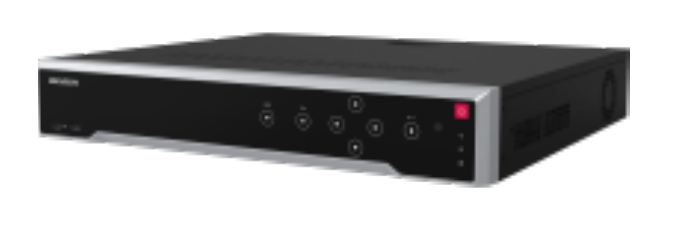
Hikvision DS-7732NI-M4 — 32-Channel M Series 8K NVR
<p>The interesting thing about this recorder is what it leaves out. There is <strong>no built-in PoE</strong>, and on a site running a cloud analytics layer that is a feature rather than an omission.</p>
<p>Cameras plugged into a recorder’s own PoE ports sit on the recorder’s internal subnet, not on the site network. They are reachable through the recorder and by almost nothing else. If anything on the LAN needs to pull frames from a camera directly, or receive an event pushed from one, that boundary is in the way. With no PoE on the chassis, every camera lands on an ordinary switch in one flat subnet and the problem never arises.</p>
<p>What it spends the money on instead is the three things a large system actually runs out of. <strong>320 Mbps</strong> of incoming bandwidth, which is roughly 14 Mbps per channel across 23 cameras and comfortable rather than tight. <strong>Four bays taking 16 TB each</strong>, so 64 TB without an expansion chassis. And <strong>two independent HDMI outputs</strong> — one at 8K, one at 4K — which means a screen behind a bar or on a shop floor can hold a fixed layout while the output at the cabinet stays free for maintenance. No splitter, no switching.</p>
<p>Two gigabit network interfaces let the camera subnet and the site LAN stay apart at the recorder. It draws 15 watts without drives, in a 1.5U 19-inch chassis.</p>
<ul>
<li><strong>32 channels</strong>, up to 32 MP per camera</li>
<li><strong>320 Mbps in, 400 Mbps out</strong></li>
<li><strong>4 SATA bays, 16 TB per disk</strong> — 64 TB maximum, plus eSATA</li>
<li><strong>Two independent HDMI outputs</strong>, 8K and 4K, plus VGA and CVBS</li>
<li><strong>Two gigabit network interfaces</strong></li>
<li><strong>No built-in PoE</strong> — cameras run from an external switch on one flat subnet</li>
<li><strong>16-channel synchronous playback</strong>, dual-stream recording</li>
<li><strong>15 W without drives</strong>, 1.5U rack chassis, 440 × 389 × 72 mm</li>
</ul>
How long will it record for?
<p>The whole calculation rests on one figure: <strong>one megabit per second of continuous recording consumes about 324 GB over 30 days</strong>. Everything after that is multiplication.</p>
<p>What people get wrong is the bit rate. A 4 MP camera on plain H.265 averages 3 to 4 Mbps, and estimates built on that number come out roughly three times too large. On <strong>H.265+</strong>, which adds smart bit-rate control on top of the codec and stops re-encoding the static parts of a scene, the same camera averages closer to 1.5 Mbps across a mixed site. A camera watching an empty store overnight drops to a trickle; the rate only climbs when something moves.</p>
<table>
<tr><td><strong>Average per camera</strong></td><td><strong>16 cameras, 30 days</strong></td><td><strong>24 cameras, 30 days</strong></td><td><strong>32 cameras, 30 days</strong></td></tr>
<tr><td>1 Mbps</td><td>5.2 TB</td><td>7.8 TB</td><td>10.4 TB</td></tr>
<tr><td>1.5 Mbps — typical on H.265+</td><td>7.8 TB</td><td>11.7 TB</td><td>15.6 TB</td></tr>
<tr><td>2 Mbps</td><td>10.4 TB</td><td>15.6 TB</td><td>20.7 TB</td></tr>
<tr><td>3 Mbps</td><td>15.6 TB</td><td>23.3 TB</td><td>31.1 TB</td></tr>
</table>
<p>Two things the table cannot tell you. Real consumption depends on how much movement your cameras actually see, which nobody knows until the system has recorded for a fortnight — which is why encoder settings are worth tuning per channel once it has. And this chassis carries <strong>no RAID</strong>: four bays means four independent disks, which maximises usable capacity but means a failed drive loses the recordings on that drive rather than rebuilding from the others.</p>
Full specification
Video, audio and outputs
<table>
<tr><td>IP video input</td><td>32 channels, up to 32 MP resolution (up to 8-ch at 32/24 MP with ultra HD resolution mode enabled)</td></tr>
<tr><td>Incoming bandwidth</td><td>320 Mbps</td></tr>
<tr><td>Outgoing bandwidth</td><td>400 Mbps</td></tr>
<tr><td>HDMI 1 output</td><td>8K (7680 × 4320)/30Hz, 4K/60Hz, 4K/30Hz, 2K/60Hz, 1920 × 1080/60Hz</td></tr>
<tr><td>HDMI 2 output</td><td>4K/60Hz, 4K/30Hz, 2K/60Hz, 1920 × 1080/60Hz (limited to 1080p when HDMI 1 is set to 8K)</td></tr>
<tr><td>VGA output</td><td>1 channel, 1920 × 1080/60Hz</td></tr>
<tr><td>Video output mode</td><td>HDMI1/VGA simultaneous, HDMI2/VGA independent</td></tr>
<tr><td>CVBS output</td><td>1 channel, BNC</td></tr>
<tr><td>Audio</td><td>1 output RCA; 1 channel two-way audio</td></tr>
<tr><td>IP speakers</td><td>Up to 8 channels</td></tr>
</table>
Decoding and playback
<table>
<tr><td>Decoding format</td><td>H.265+/H.265/H.264+/H.264</td></tr>
<tr><td>Recording resolution</td><td>32 MP / 24 MP / 12 MP / 8 MP / 6 MP / 5 MP / 4 MP / 3 MP / 1080p and below</td></tr>
<tr><td>Decoding capability</td><td>2-ch @ 32 MP + 2-ch @ 8 MP (30 fps) / 10-ch @ 8 MP / 20-ch @ 4 MP / 40-ch @ 1080p</td></tr>
<tr><td>Synchronous playback</td><td>16 channels</td></tr>
<tr><td>Dual-stream recording</td><td>Supported</td></tr>
</table>
Network and storage
<table>
<tr><td>Network interfaces</td><td>2 × RJ-45 10/100/1000 Mbps self-adaptive</td></tr>
<tr><td>Built-in PoE</td><td>None — cameras are powered from an external PoE switch</td></tr>
<tr><td>Remote connections</td><td>128</td></tr>
<tr><td>Protocols</td><td>TCP/IP, DHCP, IPv4, IPv6, DNS, DDNS, NTP, RTSP, SADP, SMTP, SNMP, NFS, iSCSI, ISUP, UPnP, HTTP, HTTPS, ONVIF 2.2, OTAP</td></tr>
<tr><td>Camera access protocol</td><td>ONVIF (v2.5), RTSP</td></tr>
<tr><td>SATA</td><td>4 interfaces, up to 16 TB per disk</td></tr>
<tr><td>eSATA</td><td>1 interface</td></tr>
<tr><td>RAID</td><td>Not supported</td></tr>
</table>
Auxiliary interfaces, power and housing
<table>
<tr><td>Serial</td><td>2 × RS-485 (half-duplex), 1 × RS-232</td></tr>
<tr><td>Alarm in / out</td><td>16 / 9</td></tr>
<tr><td>USB</td><td>Front: 2 × USB 2.0; rear: 1 × USB 3.0</td></tr>
<tr><td>Ctrl 12V</td><td>Controllable 12 VDC, 1 A output for an external alarm device</td></tr>
<tr><td>DC 12V</td><td>12 VDC, 1 A output</td></tr>
<tr><td>Power supply</td><td>100 to 240 VAC, 50 to 60 Hz</td></tr>
<tr><td>Consumption</td><td>≤ 15 W without drives</td></tr>
<tr><td>Operating conditions</td><td>-10 °C to 55 °C, humidity 10% to 90%</td></tr>
<tr><td>Chassis</td><td>19-inch rack-mounted 1.5U</td></tr>
<tr><td>Dimensions</td><td>440 × 389 × 72 mm</td></tr>
<tr><td>Weight</td><td>≤ 5 kg without drives</td></tr>
<tr><td>Approvals</td><td>FCC Part 15 Subpart B, CE (EN 55032, EN 61000-3-2/3-3, EN 50130-4, EN 55035)</td></tr>
</table>
<p>Also available as the DS-7732NI-M4/16P, the same chassis with 16 built-in PoE ports. For an enterprise recorder with a dual on-board AI engine, see the <a href=”https://smartgard.ai/ids-7732nxi-m4-16p-x/”>iDS-7732NXI-M4/16P/X</a>. For a smaller site, the <a href=”https://smartgard.ai/ds-7608nxi-k2-8p-e/”>DS-7608NXI-K2/8P(E)</a> covers eight channels with PoE built in. Specification sourced from the manufacturer datasheet, DS-7732NI-M4, V4.63.010.</p>
Works with SmartGard.AI
<p>This recorder has no on-board analytics engine, and on a SmartGard.AI site that costs nothing. The detection work happens on the cameras, which classify people and vehicles on every channel. The judgement work happens in the cloud. The recorder’s job is to record, and paying for a third analytics engine in the middle would be paying twice for work that happens at either end.</p>
<p>The absence of built-in PoE matters more than it sounds. Our edge agent reads frames from each camera and receives events pushed from them, and both of those need the cameras to sit on the same network as the agent. A recorder that puts its cameras behind its own PoE ports puts a boundary in the middle of that. This one does not, which is why it is the chassis we specify on installations where the cloud layer is part of the design from day one.</p>
<p>Continuous footage stays on the drives in this box and never leaves the building. What goes to the cloud is still frames: the images from an event when one fires, and the frames captured during a patrol when one is requested.</p>