
Hikvision HM-TD1218-2/G0/T1A — HeatPro Thermal and Optical Turret
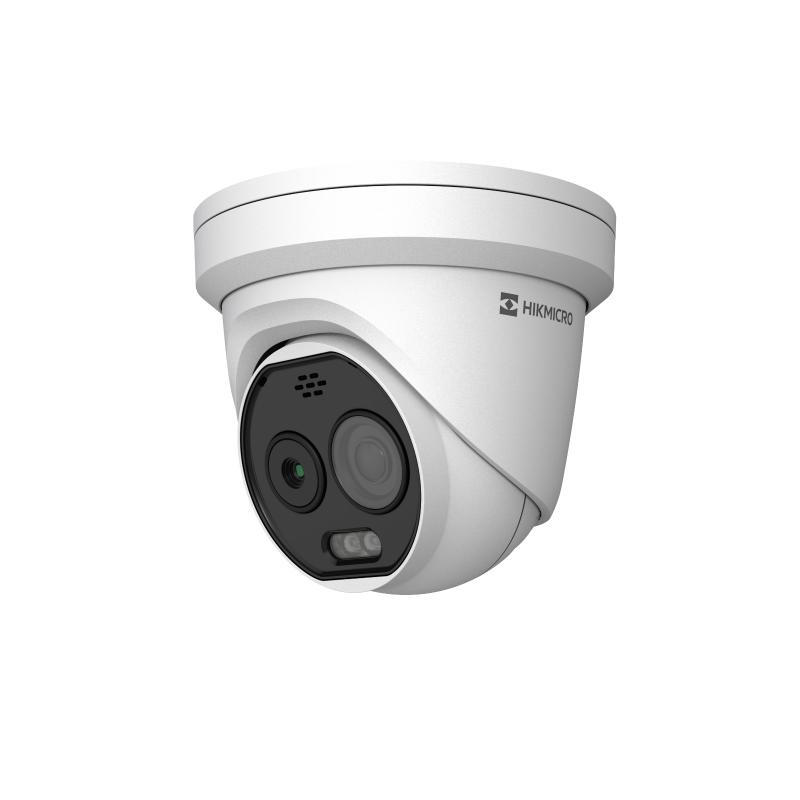
Every other camera in this catalogue works by collecting light. This one works whether or not there is any, because it is reading heat instead: an uncooled vanadium oxide array sensitive to wavelengths between 8 and 14 microns, resolving temperature differences of 25 millikelvin.
That changes what the camera is for. It notices a smouldering pallet before there is a flame to see. It watches a bearing, a battery rack or a waste pile and raises an alarm when the temperature crosses a threshold you set, anywhere from -20 to 150 °C, across up to 21 separate measurement rules. Its fire detection tracks up to ten fire points at once. None of that is possible with a lens that only sees visible light, at any resolution.
One thing to be straight about, because the spec sheet invites confusion: the thermal sensor is 160 × 120. That is normal for this class and it is not a typo, but it means the thermal channel gives you a heat signature, not a face. The 5 MP optical channel alongside it does the recognising, and bi-spectrum fusion overlays the two so you get both in one picture.
- Dynamic fire detection, up to 10 fire points tracked at once
- Temperature measurement from -20 to 150 °C, 21 rules, point, area and line
- NETD ≤ 25 mK on an uncooled VOx array, 8–14 µm
- Thermal 90° × 66.4° alongside a 5 MP optical at 119.3° × 93.3°
- Bi-spectrum fusion and picture-in-picture, 17 colour palettes
- Detection to 20 m for people, 60 m for vehicles
- White light strobe and voice alarm, 2 preset plus 6 of your own
- PoE 802.3af, max 6.5 W; IP67; -40 °C to 65 °C
What this camera actually covers
Switch between the two channels below and you will see the single most important thing about a bi-spectrum camera, which no datasheet states out loud: the two lenses do not see the same area. The optical channel is 119.3 degrees wide. The thermal channel — the one doing the fire detection and the temperature measurement — is 90. Roughly a quarter of what you watch on the monitor is outside the part that is actually looking for heat.
The distances shown are Hikvision’s published VCA detection ranges rather than DORI, because that is what they publish for this line. Set your mounting height and tilt to see where they land on the ground.
Loading the coverage diagram…
Full specification
Thermal and optical modules
| Thermal sensor | Vanadium oxide uncooled focal plane array |
| Thermal resolution | 160 × 120, 12 µm pixel pitch |
| Spectral range | 8 µm to 14 µm |
| NETD | ≤ 25 mK at 25 °C, F1.0 |
| Thermal lens | 1.8 mm, F1.1, IFOV 9.44 mrad, minimum focus 0.1 m |
| Thermal field of view | 90.0° × 66.4° (H × V) |
| Digital zoom | ×2, ×4 |
| Optical sensor | 1/2.7″ progressive scan CMOS, 5 MP, 2688 × 1944 |
| Optical lens | 2 mm, F2.25 |
| Optical field of view | 119.3° × 93.3° (H × V) |
| Optical min. illumination | Colour 0.0176 lux; B/W 0.0035 lux (F2.25, AGC on) |
| Optical WDR | 120 dB |
| Shutter speed | 1 s to 1/100,000 s |
| Image fusion | Bi-spectrum fusion, picture in picture, target colouration (white hot and black hot) |
| Colour palettes | 17, including white hot, black hot, fusion, rainbow, ironbow and sepia |
Fire detection, temperature and analytics
| Fire detection | Dynamic fire detection, up to 10 fire points detectable |
| Temperature measurement | 3 rule types (point, area, line), 21 rules total |
| Temperature range | -20 °C to 150 °C |
| Temperature accuracy | ± 8 °C |
| VCA | 4 rule types (line crossing, intrusion, region entrance and exiting), up to 8 rules |
| Detection range | People up to 20 m; vehicles up to 60 m |
Alarms, illumination and interfaces
| Light supplement | Hybrid: infrared, white light or smart mode |
| Infrared range | Up to 30 m |
| White light range | Up to 30 m |
| Visual alarm | White light alarm with adjustable flashing frequency |
| Audio alarm | VCA and temperature alarm types; 2 preset plus 6 importable voice alerts |
| Alarm input / output | 1 input (0–5 VDC) / 2 outputs |
| Audio input | 1, 3.5 mm mic in or line in |
| Communication | 1 RJ45 10M/100M; 1 RS-485 half duplex |
| Power output | 12 VDC, max. 1 W |
Video and network
| Main stream, thermal | 25 fps (1280×720, 704×576, 640×512, 320×240) |
| Main stream, optical | 50 Hz: 25 fps; 60 Hz: 30 fps (2688×1944, 2688×1520, 1920×1080, 1280×720) |
| Video compression | Main: H.265/H.264; sub: H.265/H.264/MJPEG |
| Audio compression | G.722.1, G.711ulaw, G.711alaw, MP2L2, G.726, PCM |
| Protocols | IPv4/IPv6, HTTP, HTTPS, 802.1x, QoS, FTP, SMTP, UPnP, SNMP, DNS, DDNS, NTP, RTSP, RTCP, RTP, TCP, UDP |
| API | ISAPI, Hikvision SDK, ISUP, ONVIF |
| Simultaneous live view | Up to 20 channels |
| Storage | microSD/SDHC/SDXC up to 512 GB; NAS (NFS, SMB/CIFS), ANR |
| Client | iVMS-4200, Hik-Connect |
Power, housing and approvals
| Power supply | 12 VDC ±25%, coaxial plug; PoE 802.3af Class 3 |
| Power consumption | 12 VDC: max. 6 W; PoE: max. 6.5 W |
| Dimensions | 138.3 × 138.3 × 123.1 mm |
| Weight | 940 g |
| Operating conditions | -40 °C to 65 °C, humidity ≤ 95% |
| Protection | IP67, TVS 6000 V lightning protection, surge protection |
Also listed as HM-TD1218-2/G0/T1A and HM-TD1218-2-G0-T1A. The same HeatPro platform in a bullet housing with a long thermal lens is the HM-TD2618-10/G0/T1A. Within the Hikvision UK range this HeatPro line is the one to specify for fire detection duty. Specification sourced from the manufacturer product page.
Works with SmartGard.AI
Thermal cameras have a particular kind of false alarm, and it is not the one people expect. Sunlight warming a metal roller shutter, an engine block cooling in a yard, a radiator through a window — each of these is a genuine temperature event and none of them is a fire. A threshold rule cannot tell the difference, because to a threshold they are all just heat.
The system needs one thing from a camera: the ability to report that something happened. This one reports fire detection, temperature exceptions, line crossing, intrusion and region entry. SmartGard.AI takes those triggers and looks at the frame that came with them, judging it against rules you wrote in your own words — and a description like “a hot spot in the waste bay after hours, not the loading door in the afternoon sun” is exactly the sort of thing a threshold cannot express and a reading of the scene can.
Already have cameras up? The same layer retrofits onto most modern IP installations without replacing what you already own.