
Hikvision DS-2DF8225IX-AELW(T5) — 2 MP 25x DarkFighter PTZ Speed Dome
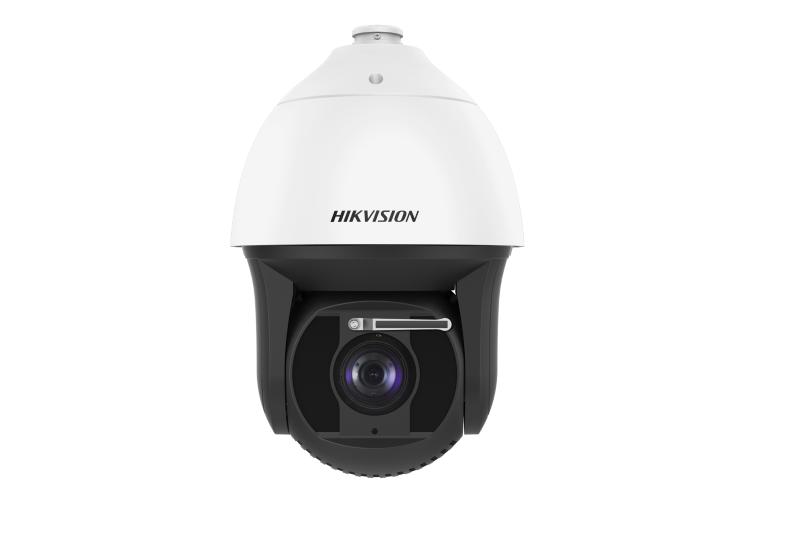
On a spec sheet this looks like a step backwards. Two megapixels, in a catalogue where four and eight are ordinary. Anyone comparing numbers in a column will skip it.
They would be wrong, and the reason is the sensor. Those two megapixels sit on a 1/1.8″ chip, roughly four times the area of the sensor in a typical mini dome, which means each individual pixel is enormous and collects a great deal more light. That is the entire DarkFighter idea: stop chasing resolution and start chasing photons. The result is 0.0002 lux in monochrome, and a picture at dusk that a higher-resolution camera would render as expensive noise.
Everything else is built for a perimeter you genuinely have to watch. Infrared reaching 400 metres. Hikvision’s own DORI figures put identification at 203 m and detection beyond two kilometres. A wiper on the front glass and a heater behind it, rated from -40 °C. Auto-tracking that follows a target without an operator. Seven alarm inputs. Eight kilograms of it, drawing up to 50 W over Hi-PoE.
- 0.0002 lux in monochrome from a 1/1.8″ sensor at F1.5
- Infrared to 400 m with smart supplement light
- DORI: identify 203 m, recognise 407 m, observe 807 m, detect 2034 m
- 25x optical zoom, 5.9–147.5 mm, 59.8° to 3.3° horizontal
- Auto-tracking, plus up to 30 faces detected and graded at once
- Fast optics-grade motion: pan to 210°/s, presets at 280°/s
- Wiper and heater, -40 °C to 70 °C, 140 dB WDR, gyroscope EIS
- 7 alarm inputs, 2 outputs, RS-485, BNC, Hi-PoE or 24 VAC
Why there is no coverage diagram on this page
Fixed cameras in this catalogue carry an interactive diagram of exactly what they see. Moving cameras do not, for two reasons.
The first is that a camera panning a full circle and zooming twenty-five times has no single field of view to draw. The second is data: Hikvision quotes one set of DORI distances for this model rather than a figure at each end of the zoom, so there is nothing to plot against focal length. Those published distances are in the specification below, and they are the manufacturer’s own.
What we will say plainly is that DORI and infrared are different limits and the smaller one wins. Detection is quoted beyond two kilometres; the illuminator reaches four hundred metres. On an unlit perimeter after dark, four hundred is the number that matters.
Full specification
Imaging, lens and DORI
| Image sensor | 1/1.8″ progressive scan CMOS |
| Max. resolution | 1920 × 1080 |
| Min. illumination | Colour 0.002 lux; B/W 0.0002 lux (F1.5, AGC on); 0 lux with IR |
| Shutter speed | 1 s to 1/30,000 s |
| Zoom | 25x optical, 16x digital; approx. 4.8 s wide to tele |
| Focal length | 5.9 mm to 147.5 mm |
| Field of view | Horizontal 59.8° to 3.3°; vertical 33.7° to 1.9°; diagonal 65° to 3.8° |
| Focus | Auto, semi-auto, manual, rapid focus |
| Aperture | Max. F1.5 |
| DORI | Detect 2034.5 m; observe 807.3 m; recognise 406.9 m; identify 203.4 m |
| Supplement light | Up to 400 m, smart supplement light |
| WDR | 140 dB |
| Image stabilisation | Built-in gyroscope-assisted EIS |
| Privacy mask | Up to 24 masks; regional exposure and focus supported |
Pan, tilt and zoom control
| Pan range | 360° continuous |
| Tilt range | -20° to 90° with auto flip |
| Pan speed | Configurable 0.1° to 210°/s; preset speed 280°/s |
| Tilt speed | Configurable 0.1° to 150°/s; preset speed 250°/s |
| Presets | 300 |
| Patrol scan | 8 patrols, up to 32 presets each |
| Pattern scan | 4 patterns, more than 10 minutes recorded each |
| 3D positioning | Yes |
| Power-off memory | Yes |
Analytics, tracking and events
| Smart tracking | Manual tracking and auto-tracking |
| Face capture | Up to 30 faces simultaneously, with tracking, capture and grading |
| Perimeter protection | Line crossing, intrusion, region entrance and exiting, with human and vehicle triggering |
| Smart event | Line crossing, region entrance, parking detection, unattended baggage detection |
| Road traffic | Vehicle detection with licence plate, model and colour recognition |
| Basic event | Motion detection, video tampering, alarm I/O |
Video, audio and network
| Main stream | 50 Hz: 25 fps; 60 Hz: 30 fps (1920×1080, 1280×960, 1280×720) |
| Sub-stream | 50 Hz: 25 fps; 60 Hz: 30 fps (704×576 downwards) |
| Video compression | Main: H.265+/H.265/H.264+/H.264; sub and third: H.265/H.264/MJPEG |
| SVC | H.264 and H.265 encoding |
| ROI | 8 fixed regions per stream |
| Audio | G.711alaw, G.711ulaw, G.722.1, G.726, MP2L2, PCM |
| Protocols | IPv4/IPv6, HTTP, HTTPS, 802.1x, QoS, FTP, SMTP, UPnP, SNMP, DNS, DDNS, NTP, RTSP, RTCP, RTP, TCP/IP |
| API | ISUP, ISAPI, Hikvision SDK, ONVIF (Profile S/G/T) |
| Simultaneous live view | Up to 20 channels |
| Client | HikCentral, iVMS-4200, Hik-Connect |
| Ethernet | 1 RJ45 10M/100M; Hi-PoE |
| Storage | microSD/microSDHC/microSDXC up to 256 GB |
| Alarm | 7 inputs, 2 outputs |
| Video output | 1.0 Vp-p / 75 Ω, PAL/NTSC, BNC |
| RS-485 | HIKVISION, Pelco-P, Pelco-D, self-adaptive |
Power, housing and approvals
| Power | 24 VAC, max. 60 W including 18 W IR and 6 W heater; Hi-PoE max. 50 W |
| Dimensions | Ø266.6 mm × 410 mm |
| Weight | Approx. 8 kg |
| Operating conditions | -40 °C to 70 °C, humidity ≤ 95% |
| Wiper | Fitted |
| Protection | IP67; lightning, surge and voltage transient protection ±6 kV |
| Safety | UL, CB, CE-LVD, BIS, LOA |
| Environment | CE-RoHS, WEEE, REACH |
Also listed as DS-2DF8225IX-AELW and DS-2DF8225IX-AELW(T5). Part of the DS-2DF82xx DarkFighter family, available with different zoom ratios and with or without the wiper fitted here. For a lighter speed dome that runs on standard PoE, see the DS-2DE4425IW-DE. Specification sourced from the manufacturer product page.
Works with SmartGard.AI
Auto-tracking is the feature everyone demonstrates and nobody quite trusts, for a good reason: a camera that locks onto whatever moved will happily spend the night following a plastic bag across a yard while the gate it was watching stands unattended. The tracking is excellent. The judgement about what deserves tracking is the part that has always been missing.
The system needs one thing from a camera: the ability to report that something happened. This one reports a lot — line crossing, intrusion, region entry and exit, parking detection, unattended baggage, face captures up to thirty at a time, and vehicle plate, model and colour. SmartGard.AI reads the frame those triggers arrive with, judges it against zone rules written in your own words, and decides whether this is worth an alarm at four in the morning.
Worth knowing if you write zone rules for a moving camera: a zone drawn against one preset means nothing at another. Tie rules to the presets that matter and let the rest of the tour simply record.
Already have cameras up? The same layer retrofits onto most modern IP installations without replacing what you already own.