
Hikvision iDS-2CD8A46G0-XZ(H)S(Y) — 4 MP Dual-Lens DeepinView Bullet
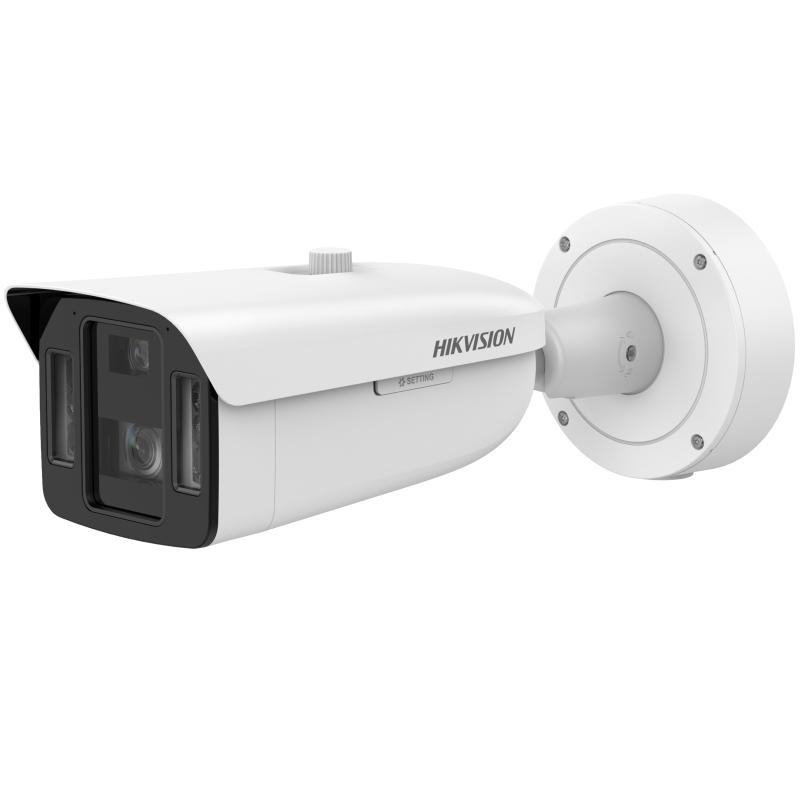
Zoom has always come with a bill attached. The moment you close in far enough to read a face or a plate, you lose the thing that gives the footage meaning: where it happened, what else was in shot, which direction they came from. Reviewers of security footage know the feeling — a perfectly sharp close-up of a stranger, floating in no particular place.
This bullet declines to make the choice. It carries two complete 1/1.8″ sensors behind two separate lenses in one housing. Channel one is an 8–32 mm zoom with a constant F1.6, identifying a face at 40 m, detecting movement to 400 m, and reading number plates at better than 98 per cent. Channel two is a fixed 4 mm at F1.0, holding 89 degrees of context at the same time, in the same recording, from the same mounting point.
The illumination follows suit: hybrid infrared and white light out to 100 m on the long channel, 30 m on the wide. Both channels run their own perimeter rules, and a demister and heater keep the front glass usable through a British winter.
- Two 1/1.8″ sensors, recording simultaneously and independently
- Channel 1: 8–32 mm, constant F1.6, identify at 40 m, detect to 400 m
- Channel 2: fixed 4 mm at F1.0, 89° of context, 0.0003 lux
- ANPR at 98%+ with a 10,000-record allow and block list
- 60 targets tracked at once; 120 faces; comparison against 150,000
- Hybrid IR and white light, 100 m on Ch.1, 30 m on Ch.2
- 140 dB WDR, 50/60 fps on the long channel, heater and demister
- IP67, IK10, EN 50121-4 railway approval, 2.2 kg of aluminium
What this camera actually covers
Three positions below rather than two, because the two channels are genuinely separate cameras. Step from the wide channel to the long channel at full zoom and you can see the entire argument for this product in one movement: 89 degrees of scene at one end, a 15 degree corridor reaching four hundred metres at the other, and both of them recording at once rather than one instead of the other. Every figure here, horizontal and vertical, is the manufacturer’s.
Loading the coverage diagram…
Full specification
Imaging, lenses and DORI
| Image sensors | Channel 1 and 2: 1/1.8″ progressive scan CMOS |
| Max. resolution | Ch.1: 2688 × 1520; Ch.2: 2560 × 1440 |
| Min. illumination Ch.1 | Colour 0.0005 lux (F1.2, AGC on); 0 lux with light |
| Min. illumination Ch.2 | Colour 0.0003 lux (F1.0, AGC on); 0 lux with light |
| Shutter time | 1 s to 1/100,000 s |
| Day & night | IR cut filter; blue glass module for reduced ghosting |
| Angle adjustment | Pan 0–355°, tilt 0–90°, rotate 0–360° |
| Lens Ch.1 | 8 to 32 mm; horizontal 42.5° to 15.2°, vertical 23.4° to 8.7°; P-iris; constant F1.6 |
| Lens Ch.2 | Fixed 4 mm; horizontal 89°, vertical 45°, diagonal 107°; fixed iris; F1.0 |
| Focus | Ch.1: auto, semi-auto, manual |
| DORI Ch.1 wide | D 150.3 m, O 59.7 m, R 30.1 m, I 15 m |
| DORI Ch.1 tele | D 400 m, O 158.7 m, R 80 m, I 40 m |
| DORI Ch.2 | D 77 m, O 30.5 m, R 15.4 m, I 7.7 m |
| WDR | 140 dB |
| Image enhancement | Ch.1: BLC, HLC, 3D DNR, defog, EIS; Ch.2: BLC, HLC, 3D DNR, defog |
| Privacy mask | 8 programmable polygon masks |
| Supplement light | Hybrid IR and white light; Ch.1 up to 100 m, Ch.2 up to 30 m; 850 nm |
Deep learning and ANPR
| Multi-target detection | Ch.1: up to 60 targets at once; human body, face and vehicle detection and capture |
| Face capture | Ch.1: up to 120 faces simultaneously, ±60° swing, ±30° tilt |
| Face comparison | Ch.1: up to 10 libraries, 30,000 per library, 150,000 total |
| Road traffic and vehicles | Ch.1: allow and block list up to 10,000 records; ANPR including motorcycles in checkpoint mode; vehicle type, colour and brand; plate recognition ≥ 98% |
| Perimeter protection | Both channels: line crossing, intrusion, region entrance and exiting, with human and vehicle triggering |
| Smart events | Scene change, audio exception, defocus detection |
| Linkage | Upload to FTP, NAS or memory card; notify centre; email; alarm output; recording |
Video, audio and network
| Main stream Ch.1 | 50 Hz: 50 fps; 60 Hz: 60 fps (2688×1520, 2560×1440, 1920×1080, 1280×720) |
| Main stream Ch.2 | 50 Hz: 25 fps; 60 Hz: 30 fps (2560×1440, 1920×1080, 1280×720) |
| Video compression | Main: H.265+/H.265/H.264+/H.264; sub: H.265/H.264/MJPEG |
| Video bit rate | 32 Kbps to 8 Mbps |
| ROI / target cropping | 4 fixed regions per stream; target cropping supported |
| Audio | Mono; G.711/G.722.1/G.726/MP2L2/PCM/MP3/AAC-LC; 8 to 48 kHz; noise filtering |
| Protocols | TCP/IP, ICMP, HTTP, HTTPS, FTP, SFTP, DHCP, DNS, DDNS, RTP, RTSP, RTCP, PPPoE, NTP, UPnP, SMTP, SNMP |
| API | ONVIF (Profile S/G/T), ISAPI, SDK, ISUP |
| Users | Up to 32, three levels: administrator, operator, user |
| Ethernet | 1 RJ45 10M/100M/1000M self-adaptive |
| Storage | microSD/microSDHC/microSDXC up to 256 GB with encryption and health detection; NAS (NFS, SMB/CIFS), ANR |
| Alarm | 2 inputs, 2 outputs (max. 24 VDC, 1 A) |
| Audio interfaces | 1 line in, 1 line out, 3.5 mm |
| RS-485 | 1, half duplex; HIKVISION, Pelco-P, Pelco-D, self-adaptive |
| Other interfaces | 12 VDC power output max. 50 mA; composite video output for debug |
Power, housing and approvals
| Power | 12 VDC ±20%, 1.90 A, max. 22.7 W; 24 VAC ±20%, 1.39 A, max. 22.3 W; PoE 802.3at Type 2 Class 4, max. 24.7 W |
| Material | Aluminium alloy body |
| Dimensions | Ø140 mm × 410.1 mm |
| Weight | Approx. 2.2 kg |
| Operating conditions | -30 °C to 60 °C; -H models from -40 °C; heater and demister fitted |
| Protection | IP67, IK10 |
| Anti-corrosion | -Y models: NEMA 4X |
| Automotive and railway | EN 50121-4 |
Also listed as iDS-2CD8A46G0-XZS, iDS-2CD8A46G0-XZHS and iDS-2CD8A46G0-XZ(H)S(Y). The -H suffix extends start-up to -40 °C, -Y adds NEMA 4X anti-corrosion. For plate reading alone in a single-sensor housing, see the iDS-2CD7046G0/EP-IHSY. Specification sourced from the manufacturer product page.
Works with SmartGard.AI
Two channels means two opinions about the same moment, and that turns out to be exactly what a judgement layer wants. The wide channel says a vehicle entered the yard. The long channel says which vehicle, and whose. Neither statement is worth much alone; together they are a description.
The system needs one thing from a camera: the ability to report that something happened. This one reports registration reads, vehicle attributes, face captures, multi-target detections, and perimeter rules on both channels independently. SmartGard.AI takes those triggers, reads the frame against zone rules written in your own words, and decides whether the answer is an alarm or silence.
Already have cameras up? The same layer retrofits onto most modern IP installations without replacing what you already own.