
Hikvision iDS-2CD7046G0/EP-IHSY — 4 MP DeepinView ANPR Camera
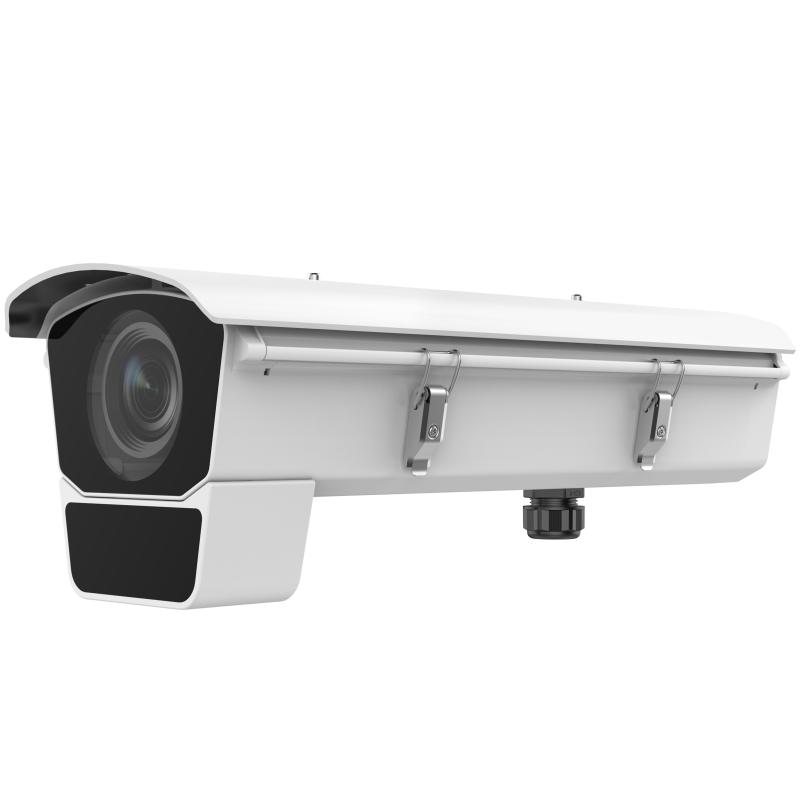
Plenty of cameras will read a number plate if the light is kind and the car is slow. This one is built for the days when neither is true.
The important detail is where the decision happens. This camera holds an allow and block list of up to 10,000 plates in its own memory, which means a barrier can lift, or refuse to, without a round trip to a server that might be busy, patched, or simply switched off. It also captures vehicles with no readable plate at all, reads motorcycles in checkpoint mode, and reports vehicle type, colour and brand alongside the registration.
The rest is built to match. A 140 dB dynamic range for the moment a car comes out of a dark ramp into daylight. Infrared to 120 metres with the long lens. A heater and a -40 °C start-up, because entrances do not stop existing in January. And 3.8 kg of aluminium in a 465 mm housing, which tells you this is site equipment rather than something you clip to a soffit.
- Allow and block list of 10,000 plates held on the camera itself
- Plate-less vehicle capture and motorcycle ANPR in checkpoint mode
- Vehicle type, colour and brand reported as metadata
- 4 MP, 2688 × 1520 on a 1/1.8″ sensor, 140 dB WDR
- Two CS-mount lens options: 3.8–16 mm or 11–40 mm, both F1.4 with P-iris
- Infrared to 80 m or 120 m depending on lens
- Gigabit ethernet, 2 alarm inputs, 2 outputs, RS-485
- Heater fitted, -40 °C to 65 °C operating, IP66, IK10
What this camera actually covers
ANPR is unforgiving about geometry. A plate has to arrive big enough and square enough to read, which in practice means a narrow view aimed along the lane rather than across it. The four positions below cover both lens options at each end of their travel. Note that identification distance is not the same as reading distance — a plate needs more pixels than a face, so treat the identify figure as an optimistic ceiling and survey the lane properly.
Loading the coverage diagram…
Full specification
Imaging, lens and DORI
| Image sensor | 1/1.8″ progressive scan CMOS |
| Max. resolution | 2688 × 1520 |
| Min. illumination | Colour 0.0005 lux; B/W 0.0001 lux (F1.2, AGC on); 0 lux with IR |
| Shutter time | 1 s to 1/100,000 s |
| Day & night | IR cut filter, blue glass module for reduced ghosting |
| Lens option 1 | 3.8 to 16 mm; horizontal 109.1° to 29.6° |
| Lens option 2 | 11 to 40 mm; horizontal 39.1° to 12.1° |
| Lens mount, focus, iris | CS mount; manual focus; P-iris; F1.4 on both options |
| DORI (3.8–16 mm) | Wide: D 57.2 m, O 22.7 m, R 11.4 m, I 5.7 m · Tele: D 206.9 m, O 82.1 m, R 41.4 m, I 20.7 m |
| DORI (11–40 mm) | Wide: D 165.5 m, O 65.7 m, R 33.1 m, I 16.6 m · Tele: D 510.3 m, O 202.5 m, R 102.1 m, I 51 m |
| WDR | 140 dB |
| SNR | ≥ 52 dB |
| Image enhancement | BLC, HLC, defog, 3D DNR, EIS |
| Privacy mask | 8 programmable polygon masks |
| Supplement light | 80 m (3.8–16 mm) or 120 m (11–40 mm), smart supplement light, 850 nm |
ANPR and vehicle detection
| Block and allow list | Up to 10,000 records held on the camera |
| Plate-less vehicles | Captured |
| Motorcycles | ANPR supported in checkpoint mode |
| Vehicle attributes | Type, colour and brand detection |
| Metadata | Road traffic |
| Perimeter protection | Line crossing, intrusion, region entrance and exiting, with human and vehicle triggering |
Video, audio and network
| Main stream | 50 Hz: 25 fps; 60 Hz: 30 fps (2688×1520, 2560×1440, 1920×1080, 1280×720) |
| Video compression | Main: H.265+/H.265/H.264+/H.264; other streams: H.265/H.264/MJPEG |
| Video bit rate | 32 Kbps to 8 Mbps |
| ROI | 4 fixed regions per stream |
| e-PTZ | Patrol and auto-tracking settings |
| Audio | Mono; G.711/G.722.1/G.726/MP2L2/PCM/AAC-LC/MP3; noise filtering |
| Protocols | TCP/IP, ICMP, HTTP, HTTPS, FTP, SFTP, SRTP, DHCP, DNS, DDNS, RTP, RTSP, RTCP, PPPoE, NTP, UPnP, SMTP |
| API | ONVIF (Profile S/G/T), ISAPI, SDK, ISUP |
| Simultaneous live view | Up to 20 channels |
| Ethernet | 1 RJ45 100M/1000M self-adaptive |
| Storage | microSD/microSDHC/microSDXC up to 256 GB; NAS (NFS, SMB/CIFS), ANR |
| Alarm | 2 inputs, 2 outputs (max. 24 VDC, 1 A) |
| Audio interfaces | 1 line in, 1 line out, 3.5 mm |
| RS-485 | 1, half duplex |
Power, housing and approvals
| Power | 24 VDC ±20%, 0.9 A, max. 21.6 W; 24 VAC, max. 22.1 W; PoE 802.3bt Type 3 Class 5, max. 24.6 W |
| Material | Aluminium alloy body, PP sun shield, PC front panel |
| Dimensions | 465.3 × 169.2 × 164.7 mm |
| Weight | Approx. 3800 g |
| Operating conditions | -40 °C to 65 °C, humidity ≤ 95%; heater fitted |
| Protection | IP66, IK10 |
| Anti-corrosion | -Y models: NEMA 4X |
| Automotive and railway | -R models: EN 50121-4 |
Also listed as iDS-2CD7046G0-EP-IHSY and iDS-2CD7046G0/EP-IHSY. A 2 MP version on the same platform is the iDS-2CD7026G0/EP-IHSY. For plate reading alongside a wide context view in one housing, see the iDS-2CD8A46G0-XZ. Specification sourced from the manufacturer product page.
Works with SmartGard.AI
An allow list answers one question very well: is this plate on the list. It cannot answer the one that usually matters more, which is whether a vehicle that is allowed to be here is allowed to be here now, doing this. A contractor’s van on the allow list is unremarkable at eight in the morning and worth a look at two.
The system needs one thing from a camera: the ability to report that something happened. This one reports registration reads, vehicle type, colour and brand, plate-less arrivals, line crossing, intrusion and region entry. Each becomes a trigger, and the vehicle metadata makes an unusually rich one. SmartGard.AI then reads the frame against zone rules written in your own words and decides whether anyone needs to hear about it.
Already have cameras up? The same layer retrofits onto most modern IP installations without replacing what you already own.