
Hikvision DS-2CD2747G3-LIPTRZS2UY — 4 MP Hybrid Light ColorVu PTRZ Dome
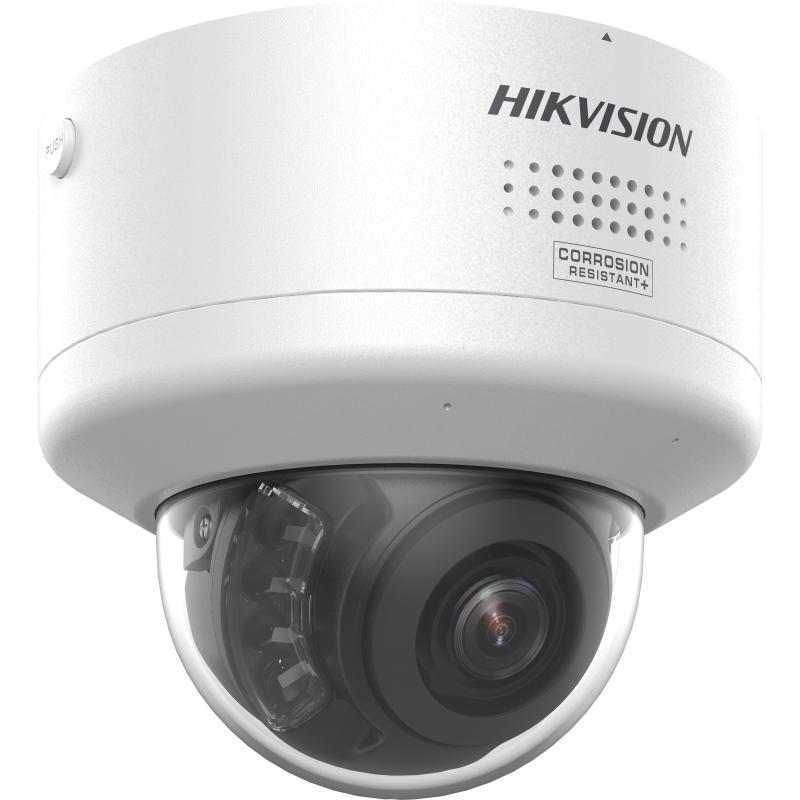
Most fixed cameras are a bet placed at installation time. You pick a focal length from a table, the installer bolts it up, and if the coverage turns out to be wrong the fix involves a ladder and an argument. This one moves that decision from the wall to the app.
The lens runs 2.8 to 12 mm under motor control, which is a genuinely large spread: 114.6 degrees across at the wide end, down to 41.8 at the long end. Pair that with PTRZ — pan 350 degrees, tilt 85, rotate 350, all set remotely — and the same part number covers a wide forecourt and a narrow approach road. The 1/1.8″ ColorVu sensor holds colour down to 0.0005 lux, and the housing carries both infrared and white light out to 40 m, so the camera can work covertly on infrared or brightly in colour depending on how you set the scene.
- 4 MP, 2688 × 1520 on a large 1/1.8″ sensor
- Motorised 2.8–12 mm, 114.6° to 41.8° horizontal
- PTRZ aiming — pan 350°, tilt 85°, rotate 350°, set remotely
- Identify to 6.2 m wide, 15.2 m at full zoom; detect to 151.7 m
- ColorVu at 0.0005 lux, F1.2, with IR and white light to 40 m
- Built-in speaker and white or red-and-blue strobe on /SL and /SRB
- 130 dB WDR, arrayed dual microphone, noise filtering
- IP67, IK10, NEMA 4X, PoE 802.3at
What this camera actually covers
This is the camera the diagram was built for. Flip between the two focal lengths below and watch the wedge collapse from a broad fan into a narrow corridor while the identification distance more than doubles. That is the whole trade in one gesture, and it is the conversation you should be having before the bracket goes up rather than after.
Loading the coverage diagram…
Full specification
Imaging, lens and DORI
| Image sensor | 1/1.8″ progressive scan CMOS |
| Max. resolution | 2688 × 1520 |
| Min. illumination | Colour 0.0005 lux (F1.2, AGC on); 0 lux with light |
| Shutter time | 1 s to 1/100,000 s |
| Angle adjustment | Pan 0–350°, tilt 0–85°, rotate 0–350°, remote adjustment (max. 1000 cycles) |
| Lens type | Varifocal, motorised, 2.8 to 12 mm, integrated mount |
| Focal length & FOV | Horizontal 114.6° to 41.8°; vertical 59.3° to 23.6°; diagonal 141.3° to 48.1° |
| Aperture | F1.2 |
| Depth of field | 1 m to ∞ |
| DORI (wide) | D 61.5 m, O 24.4 m, R 12.3 m, I 6.2 m |
| DORI (tele) | D 151.7 m, O 60.2 m, R 30.3 m, I 15.2 m |
| WDR | 130 dB |
| SNR | ≥ 52 dB |
| Image enhancement | BLC, HLC, 3D DNR |
| Privacy mask | 4 programmable polygon masks |
| Supplement light | IR and white light, up to 40 m, smart supplement light, 850 nm |
Video and audio
| Main stream | 50 Hz: 25 fps; 60 Hz: 30 fps (2688×1520, 1920×1080, 1280×720) |
| Sub-stream | 50 Hz: 25 fps; 60 Hz: 30 fps (1280×720, 640×480, 640×360) |
| Third stream | 10 fps (1920×1080 down to 640×360) under certain settings |
| Video compression | Main: H.265/H.264/H.264+/H.265+; sub: H.265/H.264/MJPEG; third: H.265/H.264 |
| SVC | H.264 and H.265 encoding |
| ROI | 1 fixed region for main and sub-stream |
| Audio compression | G.711/G.722.1/G.726/MP2L2/PCM/MP3/AAC-LC |
| Noise filtering | Yes |
Network and interfaces
| Protocols | TCP/IP, ICMP, HTTP, HTTPS, FTP, DHCP, DNS, DDNS, RTP, RTSP, RTCP, NTP, UPnP, SMTP, IGMP, 802.1X, QoS |
| Simultaneous live view | Up to 6 channels |
| API | ONVIF (Profile S/G/T), ISAPI, SDK, ISUP |
| Client | iVMS-4200, Hik-Connect, Hik-Central |
| Ethernet | 1 RJ45 10M/100M |
| On-board storage | microSD/microSDHC/microSDXC up to 512 GB |
| Speaker | 1, max. 2 W, 97 dB at 10 cm |
| Audio interfaces | Built-in arrayed dual microphone, 1 line in, 1 line out |
| Alarm | 1 input, 1 output (max. 24 VDC/24 VAC, 1 A) |
Analytics and events
| Basic event | Motion detection with human and vehicle classification, video tampering |
| Smart event | Scene change detection |
| Face capture | Yes |
| Perimeter protection | Line crossing, intrusion, region entrance and exiting, with human and vehicle triggering |
Power, housing and approvals
| Power | 12 VDC ±25%, 1.3 A, max. 15.6 W; PoE IEEE 802.3at, Class 4, max. 18 W |
| Material | Metal |
| Dimensions | Ø155 mm × 140.4 mm |
| Weight | Approx. 1230 g |
| Operating conditions | -30 °C to 60 °C, humidity ≤ 95% |
| Flashing light | /SL white; /SRB red and blue |
| Protection | IP67, IK10 |
| Anti-corrosion | NEMA 4X |
Sold under several variant names: DS-2CD2747G3-LIPTRZS2UY/SL with the white warning light and DS-2CD2747G3-LIPTRZS2UY/SRB with the red-and-blue strobe, plus fixed-lens equivalents and an 8 MP version in the same family (DS-2CD2787G3-LIPTRZS2UY). A simpler PTRZ dome without the hybrid light is the DS-2CD2143G2-LIPTRZ. Specification sourced from the manufacturer product page.
Works with SmartGard.AI
A zoom lens and a judgement layer solve two halves of the same problem. The lens decides how much detail arrives; SmartGard.AI decides whether the detail was worth sending. Neither is much use without the other, because a camera pointed perfectly at the right gate still fires every time a fox walks through it.
The system needs one thing from a camera: the ability to report that something happened. This one reports motion with human and vehicle classification, line crossing, intrusion, region entrance and exiting, scene change and tampering. Each becomes a trigger. SmartGard.AI then reads the frame against zone rules written in your own words and either raises an alarm or lets it go.
One practical note if you use the PTRZ head: zones are drawn against the view the camera had when you drew them. Re-aim the camera and the zones need a look. Get the framing right at commissioning, which is exactly what remote aiming is for, and the rules you write will keep meaning what you meant.
Already have cameras up? The same layer retrofits onto most modern IP installations without replacing what you already own.