
Hikvision DS-2CD2143G2-LIPTRZ(S2U)Y — 4 MP AcuSense PTRZ Dome
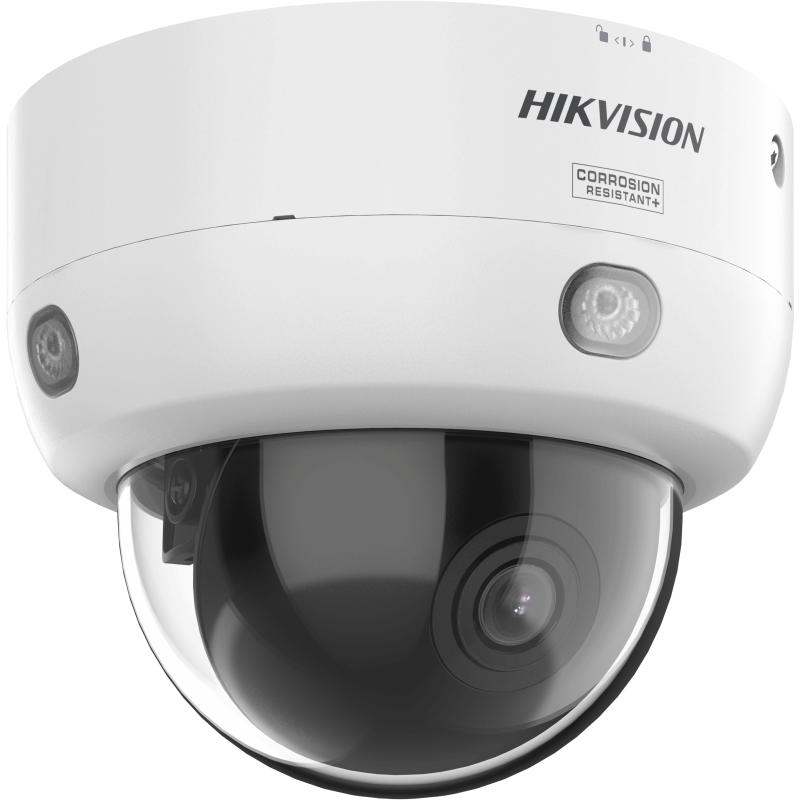
A 4 MP dome for the jobs where the awkward part is not the camera, it is the aiming. The motorised PTRZ head pans 346 degrees, tilts 75 degrees and rotates 344 degrees on command, so the view is framed from the app after the installer has come down off the ladder, and re-framed later without going back up.
AcuSense separates people and vehicles from moving branches and headlight sweep, so the alerts that reach a phone are the ones worth reading. Below you can see exactly what the camera covers at your own mounting height, rather than guessing from a table of distances.
- 4 MP, 2688 × 1520 on a 1/3″ progressive scan sensor
- Motorised varifocal 2.8–4 mm, 99.1° down to 79.9° horizontal
- Identify to 7.9 m, detect to 79.1 m at the 4 mm setting
- IR and white light to 30 m, with smart supplement light
- AcuSense human and vehicle classification, line crossing and intrusion
- 120 dB WDR for backlit doorways and gateways
- IP67, IK10, NEMA 4X anti-corrosion
- PoE 802.3at, microSD to 512 GB for edge recording
What this camera actually covers
Datasheets give you a row of DORI distances and leave the rest to your imagination. Set the focal length, your mounting height and the downward tilt below, and the two drawings redraw to match. Watch the blind zone at the foot of the pole in particular, because it is the number that decides whether a camera can identify anyone at your front door.
Loading the coverage diagram…
Full specification
Imaging, lens and DORI
| Image sensor | 1/3″ progressive scan CMOS |
| Max. resolution | 2688 × 1520 |
| Min. illumination | Colour 0.005 lux (F1.6, AGC on); 0 lux with light |
| Shutter time | 1 s to 1/100,000 s |
| Day & night | IR cut filter |
| Angle adjustment | Pan 0–346°, tilt 0–75°, rotate 0–344°, set remotely (max. 1000 cycles) |
| Lens type | Varifocal, motorised, 2.8 to 4 mm |
| Focal length & FOV | 2.8 mm: horizontal 99.1°; 4 mm: horizontal 79.9° |
| Aperture | F1.6 |
| Depth of field | 2.8 mm: 1.1 m to ∞; 4 mm: 1.3 m to ∞ |
| DORI at 2.8 mm | D 66.5 m, O 26.4 m, R 13.3 m, I 6.6 m |
| DORI at 4 mm | D 79.1 m, O 31.4 m, R 15.8 m, I 7.9 m |
| WDR | 120 dB |
| SNR | ≥ 52 dB |
| Image enhancement | BLC, HLC, 3D DNR |
| Privacy mask | 4 programmable polygon masks |
| Supplement light | IR and white light, up to 30 m, smart supplement light, 850 nm |
Video and audio
| Main stream | 50 Hz: 25 fps; 60 Hz: 30 fps (2688×1520, 1920×1080, 1280×720) |
| Sub-stream | 50 Hz: 25 fps; 60 Hz: 30 fps (1280×720, 640×480, 640×360) |
| Video bit rate | 32 Kbps to 8 Mbps |
| Video compression | Main: H.265/H.264/H.264+/H.265+; sub: H.265/H.264/MJPEG; third: H.265/H.264 |
| SVC | H.264 and H.265 encoding |
| ROI | 1 fixed region for main stream |
| Audio type | -2U models: mono sound |
| Audio compression | -2U models: G.711/G.722.1/G.726/MP2L2/PCM/MP3/AAC-LC |
Network and interfaces
| Protocols | TCP/IP, ICMP, HTTP, HTTPS, FTP, DHCP, DNS, DDNS, RTP, RTSP, RTCP, NTP, UPnP, SMTP, IGMP, 802.1X, QoS |
| Simultaneous live view | Up to 6 channels |
| API | ONVIF (Profile S/G), ISAPI, SDK, ISUP |
| Client | iVMS-4200, Hik-Connect, Hik-Central |
| Network storage | NAS (NFS, SMB/CIFS), ANR |
| Ethernet interface | 1 RJ45 10M/100M |
| On-board storage | microSD/microSDHC/microSDXC up to 512 GB |
| Built-in microphone | -2U models: 2 built-in microphones |
| Alarm | -S models: 1 input, 1 output (max. 12 VDC, 30 mA) |
| Reset key | Yes |
Analytics and events
| Basic event | Motion detection with human and vehicle classification, video tampering |
| Smart event | Scene change detection |
| Face capture | Yes |
| Perimeter protection | Line crossing, intrusion, region entrance and exiting, with human and vehicle triggering |
Power, housing and approvals
| Power | 12 VDC ±25%, 1.25 A, max. 15 W; PoE IEEE 802.3at, Class 4, max. 16 W |
| Material | Metal |
| Dimensions | Ø121.6 mm × 101 mm |
| Weight | Approx. 730 g |
| Operating conditions | -30 °C to 60 °C, humidity ≤ 95% |
| Protection | IP67, IK10 |
| Anti-corrosion | NEMA 4X |
Also available with different microphone and audio options, and as an 8 MP equivalent on the same PTRZ dome platform (DS-2CD2146G3-IPTRZ family). Specification sourced from the manufacturer product page.
Works with SmartGard.AI
SmartGard.AI does not replace this camera, or the recorder behind it. It sits on top of both and decides which of their alerts are worth waking someone up for.
The system needs one thing from a camera: the ability to report that something happened. This one reports plenty — motion with human and vehicle classification, line crossing, intrusion, region entrance and exiting, scene change and tampering. Every one of those becomes a trigger. SmartGard.AI then looks at the frame it arrived with, judges it against zone rules written in your own words, and either raises an alarm or stays quiet. Most of the time it stays quiet, which is the entire point.
Already have cameras up? The same layer retrofits onto most modern IP installations without replacing what you already own.